Monthly Archives: October 2016

The City and the Ship
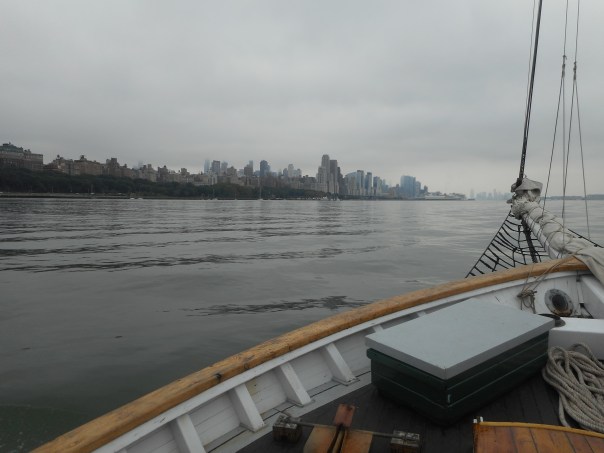
The Clearwater approaches her dock in Manhattan
The sloop Clearwater has a berth in New York City, 79th street on the west side of Manhattan. This is the southernmost dock for the sloop, and the most urbanized. While the ship’s surroundings can change drastically at different ports, daily life on the boat remains much the same.
The 79th Street Boat Basin sits beside a long stretch of parkland in the city, a thin insulating strip of green that buffers the recreational waterfront from the tumult of the city. Access into the city is by crossing through the open air Boat Basin Café onto the terminus of 79th street. Going through the arches of the café is like stepping into a rabbit hole; an entirely different world exists onshore.
A few blocks away from the docks runs Broadway. In the residential Upper West Side, the street is well trafficked but lacks the frenetic aura it is caricatured for. Continue along Broadway until it begins its southeast turn; the buildings soon become larger and more commercial. A few miles further on lies Times Square. At the heart of the city, the hustle and bustle grows to its climax here. Flashing lights and monumental billboards scream for your attention. The pace of life seems to quicken, and you can almost feel the chaotic energy of the square seeping into your veins. The metabolism of the city is high. It’s calling you to see and do and consume.
The big city is fun and exciting. There is lots to see and experience. Somewhere, at all hours, something is going on in the city that never sleeps. A diversity of people walk the street. New sights and sounds lurk around every corner. The smell of exotic foods wafts from street vendors. A lifetime of exploring could never discover all the corners of such a metropolis.

Times Square at night
I find the city lively and exciting. Its abundant stimuli rouses the mind. But I can easily get overwhelmed by the city.
I prefer the simple life instead. The boat, though basic, is homely and comforting. The bounds of the ship are fathomable to an overworked mind, and the intricate corners and inner workings are knowable with time and care. The 76 foot length of deck serves as the bounds of my home, one that I share with 18 others. Down below deck, 36 cubic feet of space is all that I can claim as my own, which serves as my bed and storage space by night, but doubles as a couch during the day. Inside the ship, the spontaneous whims of the city don’t find their folly. Instead, a set schedule adds structure and predictability to daily life. Life onboard is a ritual of sorts.
It is a lifestyle of simplicity, not excess or extravagance. On the Clearwater there are no fancy restaurants or fine dining. Vegetarian meals are shared with the crew, who gather together to eat in the cozy main cabin, sitting on the floor or perching on bunks to make room. The fare, whole and nutritious, sustains the body after a day of labor. No fancy dress or designer clothing are required onboard. The dress code is one of practicality and pragmatism. Most of the crew onboard have just a few articles of clothing, second-hand flannel shirts and thread-bare workwear. The grassroots vibe emanates still from the earliest days of Clearwater. Crew all contribute their part to the internal functioning of the ship. Daily chores and tasks are shared among shipmates in this communal setting.
Far fewer people live on the boat than in the city. But instead of a metropolis full of people whom you never get to meet, the boat is full of people you quickly get to know. Working closely during the day transitions to hanging out later at night. We play music together, and share in conversational rabbit trails. Daily life on the boat is an exercise in communal bonding of the sort that gets a boat to run and sustains an idea of environmental activism.
On a night at 79th Street I can crawl up on deck from below. The lights of the big city surround me. Red and white glowing orbs from traffic continually roll past and the noise of urbanity lingers still. Looking up I can see the lighted spire of the Empire State building and I know that I’m in the heart of America’s most densely populated city. But things are calm and quiet on the sloop upon the Hudson.
I much prefer my little ship in Manhattan.

Learning the Ropes
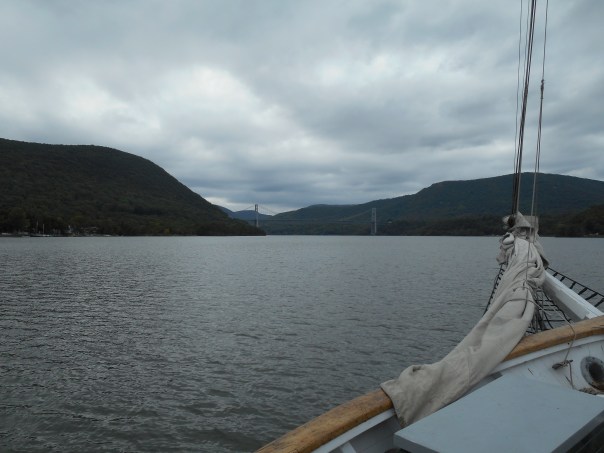
The sloop Clearwater sailing through the Highlands section of the Hudson River
“It is not that life ashore is distasteful to me. But life at sea is better.” –Francis Drake
I’ve been learning the ropes lately, so to speak.
It’s been two weeks on the Hudson River Sloop Clearwater, in a crash course on boatsmanship and environmental education. I’m a sailor now, though I’m not yet as salty as my boots are from swabbing the deck with brine.
Foremost, learning the ropes entails that a rope isn’t just a rope—it can be a line, a sheet, a halyard or a downhaul. The nominal difference doesn’t mean much to a landlubber’s hands, though—every rope helps aid in developing the all-important sailor callus. Two weeks in and I can now flop-flake a downhaul, dogbone a line, or Ballantine a halyard. Better yet, I know what all those terms mean too. But learning the ropes goes beyond just the ropes—among other things I’ve learned how to hoist up the main sail, steer with the tiller, be a dock jumper, and furl the jib.
Confused by any of the terms yet? Sailing culture has its own lingo. Rarely does a component of a boat share its name with its onshore counterpart. The cook prepares food in a galley, not a kitchen. Below deck, we walk upon the sole instead of floors. And, using the head on a ship is an entirely different thing than using your head on land. By now, practical experience has resolved my long-standing confusion of which side of the boat is port and which is starboard. There are so many new and funny-sounding terms to learn: jib, gaff, shroud, boom, peak, throat, transom, fo’c’s’le, dogged, pin, cleat, lazy jack, and my favorite new term baggywrinkle. Though we may be on a tall-masted historic ship, we aren’t pirates. No arrrghs or ahoy mateys found here.

The 106-foot long Clearwater under full sail
The Clearwater is very much an educational ship. Its revolving crew of apprentices, interns, and volunteers, who stay for one week to a few months, means that new hands are always coming aboard to learn the ropes for themselves. This means that onboard the ship is an active learning environment; new crew learn from their shipmates, and those aboard for longer gradually switch from primarily learning to teaching as well. Two weeks in and I’m happy that I can now ‘show the ropes’ to newcomers. The constant influx of trainees and volunteers serves as an indicator of the grassroots origins of the Clearwater, which was founded by Pete Seeger and other activist musicians in the late 1960’s to educate and create awareness about issues of water quality. Clearwater’s alumni crew number many and all contribute their part to the mission of the ship in a different way.
New crew members get one full day of formal training before taking part in educational sails. The rest of learning on the Clearwater is done practically—learning by doing. The process of sailing itself proves to be very educational, and with around 20 sails now under my belt, I’m beginning to feel quite comfortable at the undertakings. Tasks onboard are done in a progression of difficulty. Prove yourself capable of performing one task, and the captain or mate will assign you to something more challenging. Each day and each sail is a little bit different, so there’s always something new to learn. Standing by as a deckhand, you never know which task the mate will assign you to—and once you’re told, you just have to repeat back the command and perform the task with minimal preparation. Learning by doing on such a large sailing vessel seems like a high-stakes game, but everyone’s looking out for each other to make sure the crew is learning well and performing their best.
Education aboard the Clearwater extends from training the crew to instructing the participants on the ship’s many educational sails. The primary focus of Clearwater is the educational sails, and a typical day sees two three-hour sails of this type take place. All of the crew onboard are not only sailors but are also educators, and will lead a variety of educational curricula. Students who sail are as young as fourth graders and as old as college students. Just like every sailing condition is different, every educational program is tailored to the needs and learning level of the group. The basics of each educational sail remain the same, with participants helping to hoist the sails before going to different learning stations covering aquatic life, water quality, Hudson River history, and navigation. As someone not from the Hudson River watershed who knew little about the river before sailing, I’ve ended up learning as much about the Hudson River as the students I teach. At first, teaching the standard material is being only one step ahead of the group in knowledge. After a number of sails, though, I’ve found I’ve learned enough to teach more and more, and every new sail presents an opportunity to teach the same material in a different manner. And, I absolutely love it when people ask me a question that I’ve just learned the answer to.
Learning the ropes also means adjusting to a different lifestyle. A life on the river is different than a life on land, particularly when you live on a replica of an 18th century cargo ship. The modern conveniences of life aren’t found in the living quarters. There is no air-conditioning or heating, no refrigeration, and only limited electricity and running water. Our restroom situation is as simple as using a five-gallon bucket. Living on the ship really shows you how much—or how little—it actually takes to live. The social environment is an adjustment too. With a crew of up to 19, quarters are close on the 76 feet of Clearwater’s deck. You have to be comfortable not only working closely with people, but also living with them on your time off. However, the Clearwater tends to attract a certain type of person who can thrive in a tight community aboard an active sailing ship. The community onboard the ship has been the best resource for learning to sail and one of the biggest highlights of learning the ropes.
Learn more about the sloop Clearwater at http://www.clearwater.org

1,234.63 Miles Later

Stopping in Chicago along the way
My bicycle hobbled over the pavement for the final stretch, rims wobbling, bearings creaking at every turn. One thousand miles of loaded travel puts a great deal of wear on a bicycle. Tires bald, brakes worn down, dozens of new scratches in the bright yellow paint. I rode with baited breath my final day, hoping that my emergency tube patch job would hold after blowing my last spare on a particularly aggressive Indiana pothole the night before. Braking for the last time on my parent’s uphill driveway, I came to my final stop. 19 days. 1,234.63 miles.
It was a rather uneventful end for such a long trip. Arriving at my destination felt no more different than returning from a short evening ride. The cheering spectators, the paparazzi that I’d expected were absent. I had thought that my trip would deserve an epic fanfare, a grandiose welcome after such a long physical exertion. What I got instead was a simple welcome home from my parents. Soon enough thoughts of riding drifted away from my mind as I integrated myself into my parent’s nightly television routine. Coming back from three weeks of biking felt little different that coming back from a day at the office
I ended up cutting my trip short by a day. Camping in Indiana on what would be my final night, I made the decision to push through and make it all the way to my destination instead. To myself I had already proven my capability to endure the journey; all I needed to do was complete the trip. Instead of leisure and sightseeing on my final day, I just put my head down and rode. Peddle after peddle, mile after mile kept adding up until I amassed 113 in one day. With goal in site, no time to relax—just time to ride.
The most intense feeling I had on my final push was one of relief. Biking north out of Michigan City, I caught glance of the giant blue “Welcome to Pure Michigan” road sign. After so long away, finally back in my home state. A lump grew in my throat and my eyes teared up as I crossed the state border.
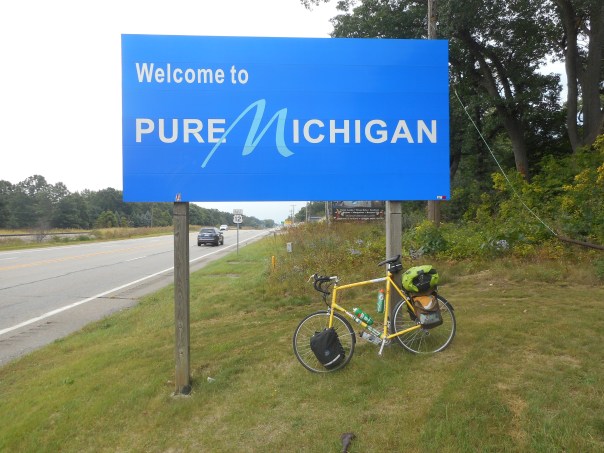
Overcome by sentiment at reaching the state line
Later on, coming into the outskirts of Holland, that same emotional relief came over me; ‘I recognize this place now’, I thought to myself, ‘I know where I am. From here it’s only 4 miles, 3 miles, 2 miles…’ To the onlookers curious at why the overburdened cyclist was sobbing, there is only one simple response:
I had made it
What difference does it make now that such an arduous trek is behind me? Already the memories of the toil are fading. The afterglow was short-lived. A few hours after arrival I found myself showered, rested, and unpacked from the journey. No time to bask in remembrance, and only a few people to recount the adventure for. Instead I had pressing work to prepare for my upcoming job.
But already I feel nostalgia for the journey. The lactic acid has since drained from my legs and I’ve forgotten how sore I felt on the expedition. Rosy retrospection smiles kindly upon the difficulties, and I find myself yearning for more. A journey of one thousand miles, and I had chosen to stop in the middle of America when more road lay yet before me.
After such a long journey, after such a feeling of relief when I finally made my destination and could rest, I realized one thing:
I could have still kept biking on.
 In All Directions