Category Archives: Te Araroa

Seeking Darkness

.
.
In a blog post from last September, I wrote how I felt like I was ‘chasing light’ by hopping from summer in the northern hemisphere to catch another summer in New Zealand, only after doing similar hemisphere-hopping travels the year prior. Now, back in the northern hemisphere, we have recently passed the summer solstice—the day with the most light each year. For me, this marks five summer solstices in a row without experiencing a winter solstice. I, indeed, have been chasing light.
But, in my hemisphere-hopping quest for summer light, I found myself inevitably pursuing just the opposite. After experiencing so many summers in a row, I ended up, quite literally, seeking darkness. Sometimes rather desperately.
The details were that I was following along a thru-hike in New Zealand. Te Araroa—New Zealand’s longest trail—which I tramped my way along from last October through February. Peak summertime in the southern hemisphere. Long summer days filled with ample sunshine in New Zealand’s high latitudes. And I was outside camping for all of it.
In spite of this, I began to seek out the darkness like a nocturnal animal. Though backpacking and camping itself are most practically done during daylight hours, my sleep schedule shifted to be more night-oriented. I was desperately craving the dark. Always an early-bird before, I instead felt the pull to become a night owl.
My daily hiking routine was far different from most other trampers. I would lollygag and nap my way through the afternoon’s hiking route—I never felt in a rush to get anywhere—and this resulted in a delayed arrival at the campsite or hut later in the evening. Daily chores of setting up camp and cooking dinner would take me even later into the evening hours. While nearly all my hiking compatriots would be in bed sleeping before sundown, I would continue to stay awake. At the fall of nighttime, I would feel a sense of relief. Reawakened, reinvigorated by the dark, I would remain conscious. I was enlivened again. Aside from a little bit of stargazing, seeking out glowworms, or swimming with bioluminescent algae, I tended to not explore much after dark. Instead, I cocooned. I would cozy up in my tent or in the hut. I would read or journal. Or, failing that, I would just lie awake and think. My mind was becoming clear and active. It was no time for sleep.
Delayed bedtimes from my nighttime activities resulted in delayed mornings. Late nights meant later waking times, and increasingly later starts to the hiking day. My daily routine of wake-hike-camp-sleep kept creeping later and later into the day. I got into an inefficient (by thru-hiker standards) pattern of waking around 10 or 11am, leaving camp by noon or later, and arriving at the next camp just before sundown (or, in some cases, after sunset). I started setting up my camp and cooking dinner exclusively by the wane light of a headlamp. And since I never wanted to go to sleep immediately after making camp, I continued to stay awake after dinner reading and journaling by the dim glow of a red light. The spiral of becoming more nocturnal continued.
Keeping this kind of sleep schedule meant that upon waking in the morning, nearly always everyone else at the huts or campsites had already departed. I would thus be greeted by a peaceful morning of blissful solitude in a beautiful location. Upon arriving at the next hut or campsite the following evening, I found most of its occupants would already be in bed, or pretty darn near to it. A direct result was that I started talking less and less to my fellow Te Araroa trampers. I became a temporal recluse. I embraced the quietness and seclusion that night offered, and I basked in this new-found introverted time.
In essence, I think what I was craving was not the darkness itself, but something that the dark provided. Nighttime can facilitate certain events and emotions that the daytime cannot do justice. Darkness sets a certain mood and ambiance, and that was what I had been craving for so long.
Summer seasons, with their long days and ample light, play host to social gatherings and long adventurous outings in the outdoors. Summer is an externally-focused season, with an emphasis on travel, exploration, and sociality. Winter seasons, in contrast, play host to a quieter, more subdued, more introspective disposition. The darkness closes off the self to much of one’s surroundings—the world becomes more limited, and the internal self begins to take focus. The snug coziness of one’s safe protected domicile on a dark winter’s day offers a feeling of security that cannot be matched by the bright and benign summer. From this position, one can look inwards at oneself, reflect, grow, introspect.
With so many summers in a row under my belt, I think my body and soul were craving that dark introspective rest period to relax and mentally digest all my recent experiences. Leading up to Te Araroa, I had undergone many long adventurous summer days of travel, socializing and exploration—a summer guiding canoe trips in the Boundary Waters, a summer working at a research station in Antarctica, an entire summer spent leading a backpacking trip on the arctic tundra of Alaska. Then to top it all off, I started on this long endeavor of a thru-hike on New Zealand’s longest trail. All this movement and exploration simply became too much for my own desires. Instead, I was craving a more relaxed pace—just to have some time to sit and process through everything I had done while the days were long and my thirst for adventure was high.
Personally, I find myself quite cognizant and responsive to the change in seasons. I grew up in a temperate climate. The places I call home are marked by a strong seasonality from summer into winter and back again. Furthermore, I have chosen to pursue a career as a seasonal worker in the outdoor industry, where the arc of my year follows the progression of the seasons—and I am outdoors witnessing the changes for most of it. In the temperate climates I call home, there is a distinct period of rapid growth and activity, followed by a period of rest and dormancy.
The plants in the temperate landscapes where I grew up have adapted to this seasonal cycle. In fact, many cannot live well or reproduce if the hard winter cycle is broken. Buds fail to open, flowers fail to bloom, seeds fail to germinate. The changes in the plants’ metabolism are triggered by changes in light and cold—processes known as cold stratification and vernalization. As a plant connoisseur, I am in-tune with the plants around me. And similar to the plants, I need these seasonal cycles for my own healthy biology.
There was only one other time in my life where I felt acutely the lack of change in seasons. It was the first time I had ever skipped a winter, opting to spend October through April in Australia instead of in the northern hemisphere. Coming back to America the following summer, I felt like something wasn’t quite right. I felt like I had missed that vital internal reset period that feels so intrinsic to my nature.
Now, as summer has officially started and the solstice has passed, darkness will ever so slowly return to the northern hemisphere. This time, I am staying put in the north for the foreseeable future. Darkness, and all it brings, will finally come to me. No longer will I have to stay up so late desperately seeking darkness. I will finally get the strong seasonal reset period that my body and mind have been craving. It may be the height of summer now, but I’m already looking forward to winter.

Te Araroa Packing List
.
Let me confess that I am not an ultralight backpacker. Or that I even concern myself much with the weight I carry in my pack. When on a camping trip, I like having all the various comforts and amenities along with me, and no matter how heavy my pack is I still find a way to carry it. My tendency to overpack is not helped by owning a 100-liter pack that, no matter the length of the trip, I somehow always find a way to stuff full.
Ultralight backpackers, on the other hand, become obsessed with ounces. Experienced ultralighters can get the base weight of their gear down to 15 pounds or less. They find myriad creative ways to reduce weight, like cutting off the handle of their toothbrush or using a tent-stake as an eating utensil instead of packing a spoon. Yuck! Personally, I don’t mind carrying the extra ounce to have a spoon that is solely reserved for eating.
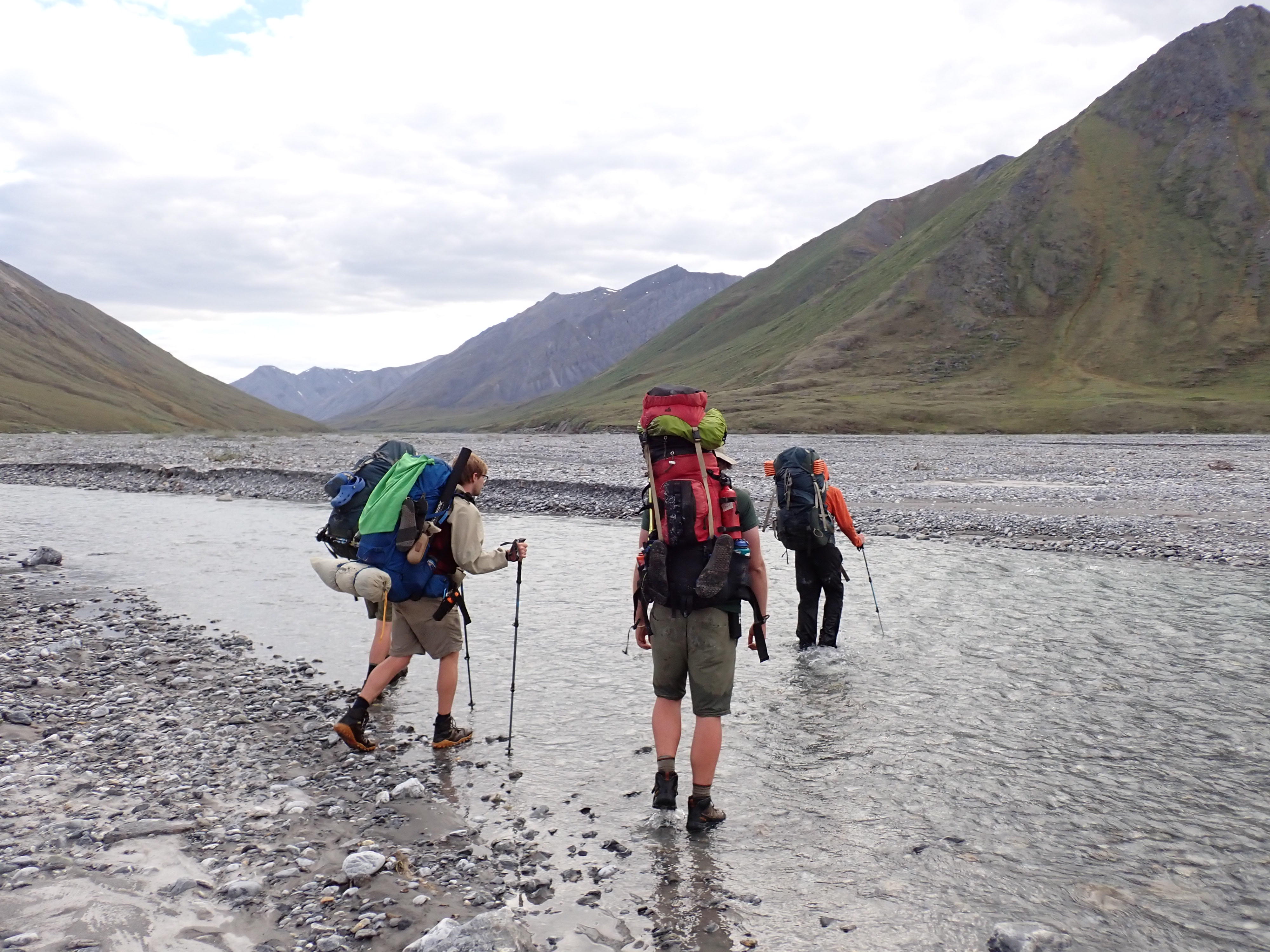
The bulk of my backpacking experience comes from working as a trail guide at YMCA Camp Menogyn, which, with its emphasis on extended backcountry expeditions for youth, is concerned more with carrying all the necessary gear for an expedition and is less concerned about how much all of it weighs. Menogyn is not an ultralighting outfit in any sense of the word. This past summer, I led the longest backpacking trip that Camp Menogyn offers for its participants, a 40-day excursion to Alaska’s Arctic National Wildlife Refuge (ANWR). My 100-liter pack’s base-weight was somewhere around 40 pounds. Add in shared group gear and provisions for two weeks at a time, and my pack could weigh as much as 70 to 80 pounds—or more! Aside from weigh-ins for our bush plane flight, we weren’t too concerned about how heavy our packs were. All we really knew was that they were heavy!
Backcountry camping Menogyn-style, we needed to carry all that we could envision needing for forty days in the wilderness—repair kit, first-aid kit, extra food rations. Gear breaks and needs to get fixed, the food resupply plane might not arrive on time due to weather, and we needed ample first-aid kit supplies for anything upwards of a grizzly bear attack. Backcountry camping is about carrying enough supplies and knowing how to use them to prepare for every eventuality. But of course, it’s not just all about the necessities either. My group carried, for our entertainment, the luxury of a frisbee and plenty of books as well. And no, none of us ripped apart and burned the pages of our books as we read them—not even David Foster Wallace’s 1,079-page tome Infinite Jest. My reading on this trip included a book about two authors/filmmakers who spent five months in the Canadian and Alaskan Arctic following caribou—though their packs weighed upwards of 100 pounds with camera gear and provisions, they still found the wherewithal to pack a George W. Bush doll so that President Bush could too see the Arctic (cue the video in the link to 3:45 to see the Bush doll’s cameo).
As I transition from an extended backcountry expedition in Alaska to a thru-hike of New Zealand’s Te Araroa trail, I’ll be encountering a very different style of backpacking than I’m used to and have been trained on. So different in fact, that I might as well be starting from scratch! Aside from a lot of the gear looking similar, not much of the practice of travel is the same.
Backcountry camping, like I am accustomed to, is about spending a significant portion of time in federally-designated wildernesses, or areas with little human influence. Thru-hikes, which include more famous trails such as the Appalachian Trail and the Pacific Crest Trail as well as Te Araroa, also pass through many wildlands—but include lots of contact with the developed world as well; in the case of Te Araroa, the trail passes directly through New Zealand’s two largest cities, cuts through miles of sheep pasture (it is New Zealand, after all), and is around 15 percent hiking on roadways.
Another large difference is that backcountry camping does not necessitate hiking a large number of miles each day. In ANWR, our group averaged just four miles of ‘progress’ each day towards our end point of the Dalton Highway. This relaxed schedule allowed us to be free to set out on day-hikes and wander more or less where our hearts desired within the Refuge. In fact, Arctic National Wildlife Refuge has no designated hiking trails. On Te Araroa, the objective will be to get from Point A—Cape Reinga, the northernmost tip of New Zealand’s North Island—to Point B—the city of Bluff, the southernmost tip of the South Island. I will be following closely the trail of Te Araroa the whole time—hopefully not head-down looking at my feet constantly, but looking about and enjoying the scenery. But ultimately follow the trail I will, and the daily goal will be to put on the miles to complete the trail in an ever-shrinking time window (my hiking partner Annemarie has a firm deadline to return to work at McMurdo Station, Antarctica, and I last-minute delayed my start on the trail by about two weeks when an opportunity popped up the night before my departure). With 2,000 miles to cover, and potentially only 3 ½ months to do it in, we could be faced with hiking an average of 19 miles a day. Woof!
Finally, the difference in the food. In ANWR, my trailmates and I carried so much food on our backs—up to 15-days’ worth—because we could only get resupplied only so often by bush plane. In order to carry that many meals, our food needed to be dehydrated, and all 40 days’ worth of food was packed well ahead of the trip itself. Given the amount of time that our dehydrated trail food spent sitting in thin plastic bags all squished together, it is no surprise that all our provisions tended to meld into the same generic trail-food taste. With thru-hiking, I do look at food as being an upside. While the South Island of New Zealand does have several long sections between towns, the number of miles we will cover each day will allow for more frequent resupplies of our provisions. And also the chance to eat at restaurants and fast food! Indeed, my perception of thru-hiker victuals is hiking all day long just to eat at the next McDonalds.
With all this in mind, here’s what I currently have planned to take on Te Araroa. I did myself a favor by downsizing to a 65-liter pack so that I can’t stuff it too full. Currently I have my base weight down to just under 30 pounds. How much of this stuff I will still be carrying at the end of the trail will be a guessing-game over the next 2,000 miles. I included brand names and trade names just to be specific about the gear I have, but recommend finding whatever works best for you, whether brand name or not. I myself have little brand loyalty and have amassed my outdoor gear collection via Craigslist, the REI® Garage Sale™, and discount sections at outdoor gear stores.
.

.
Backpacking and Sleeping Gear
- Osprey® Rook™ 65-Liter Backpack
- Mountainsmith® trekking poles
- REI® Zephyr™ 25⁰ synthetic sleeping bag
- Sea to Summit® Thermolite™ sleeping bag liner (+10⁰)
- Nemo® Tensor™ inflatable sleeping pad
- The North Face® Asylum Bivy™ single person tent
Clothes
- Hiking Clothes
- 1 sunhat1 pair sunglasses1 synthetic shirt1 Original Bug Shirt Company® bug shirt1 pair synthetic underwear1 pair trail running shorts1 pair synthetic socks1 pair La Sportiva® Bushide™ trail running shoes1 cotton handkerchief1 rain jacket
- 1 pair rainpants
- Non-hiking clothes
- 1 synthetic shirt1 lightweight fleece1 medium weight fleece1 puffy jacket1 pair synthetic underwear1 pair synthetic convertible pants/shorts1 cotton handkerchief1 pair lightweight gloves1 beanie1 pair Xero® sandals1 pack-towel
- 1 pair synthetic socks
.
.
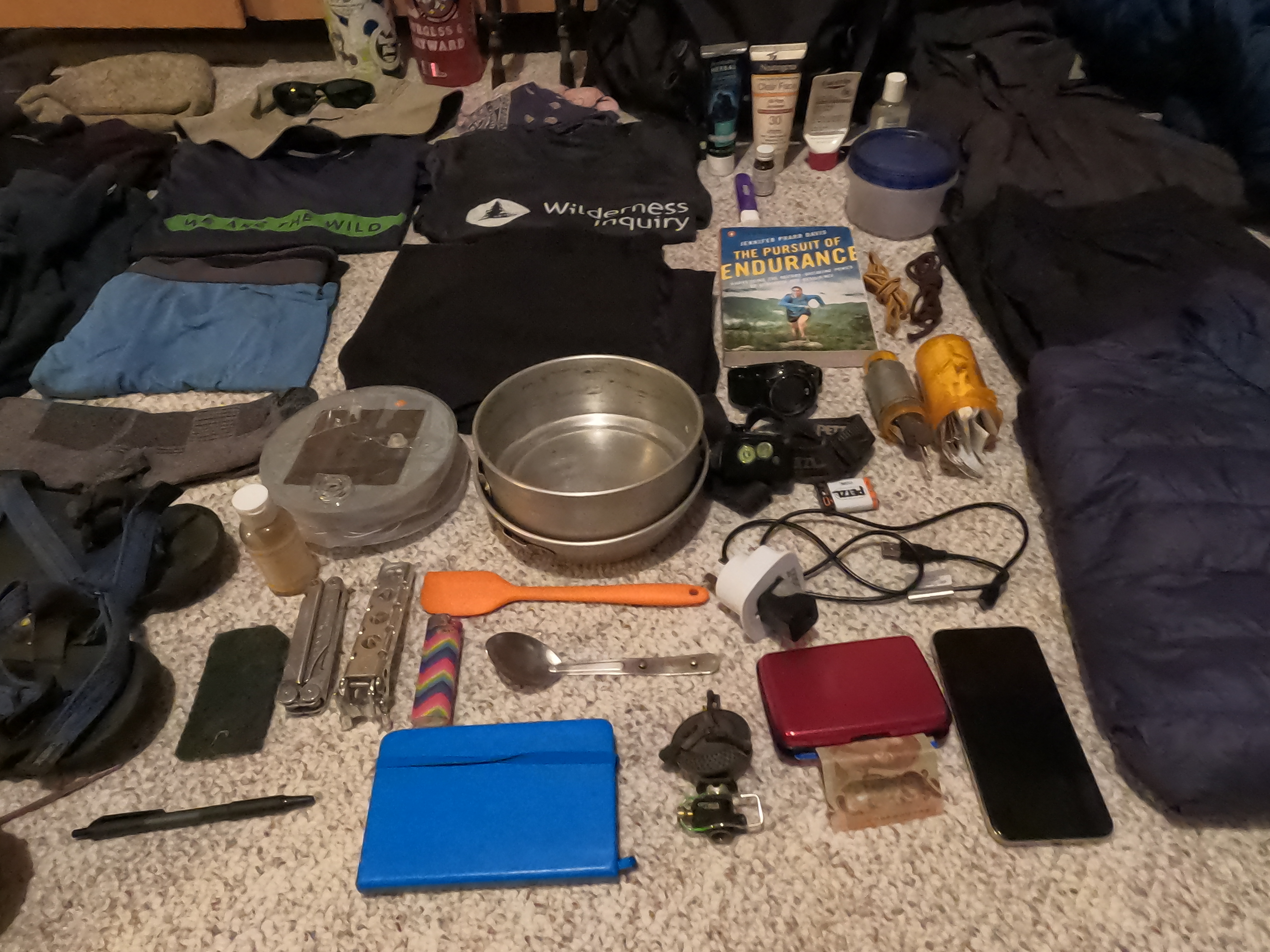
Cook-Kit
- Optimus® Crux™ stove with case (uses isobutane/propane fuel available in New Zealand)
- 1 2-liter aluminum cookpot
- 1 potgrips
- 1 spoon
- 1 rubber spatula
- 1 Leatherman® multi-tool
- 1 plastic tupperware
- 1 lighter
- 1 small bottle Dr. Bronner’s® biodegradable soap
- 1 small green Scotch-Brite™ pad
- 1 bottle Potable Aqua® iodine tablets (50-count)
- 1 stuff-sack for carrying food
- 2 32-oz Nalgene® water bottles
Toiletries
- Small tube of toothpaste
- 1 travel toothbrush
- Small tube of sunscreen
- Small tube of hand lotion
- Small bottle of hand sanitizer
- 1 small first-aid kit in an old pill bottle
- Moleskin®Assorted small bandages1 roll athletic tapeAnti-biotic ointmentDiotame anti-diarrheal tabletsIbuprofenHydrocortisone creamSmall and large nail clippers
- Tweezers
Electronics
- Petzl® Actik™ headlamp with rechargeable battery
- Luci® Base™ solar charging lantern
- New Zealand wall outlet adapter
- American charging block
- Charging cord compatible for all electronics
- Smartphone (to use for photos, staying in contact, and navigation apps for the Te Araroa)
- Wristwatch
Extras
- 1 Repair Kit (fitting inside old pill bottle)
- Gear repair tapeInflatable sleeping pad patchesThin sewing threadThick waxed sewing threadAssorted sewing needlesSafety pinsZip tiesDuct tape wrapped around pill bottle
- 2 spare shoelaces
- Journal
- Pen
- Book (Jennifer Pharr Davis’s The Pursuit of Endurance. Why not start off with a book on running the Appalachian Trail?)
- Aluminum wallet with ID, New Zealand cash, and credit cards
.
Happy Trails!
.
.
 In All Directions