Blog Archives

Breakfast from a Dumpster
In all my years of dumpster diving, I’ve never been in a market quite as reliable as Grand Rapids. As a result, I always seem to have an odd abundance of usable dumpster-rescued food items that need to be eaten. As the diver never knows what treats lie in store each night, the contents of the magical mystery pantry often require creative thinking in order to prepare novel and tasty food dishes.
In this episode of Dumpster Kitchen, I tried to solve the problem of 120 corn tortillas and a bunch of (slightly bruised) organic bananas. A sweet breakfast treat seemed on hand…
Ty’s Creamy Banana Breakfast Tacos
Ingredient List:
- Oil
- Bananas*
- Milk
- Honey
- Cinnamon
- Almonds
- Corn Tortillas*
*Denotes dumpster-dived ingredients
Step 1:
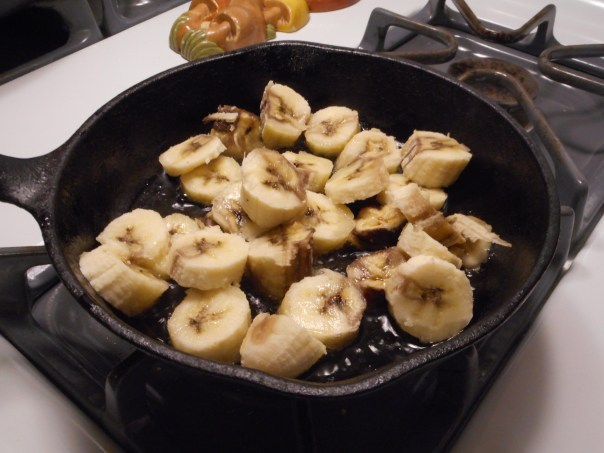
In a small skillet, pour enough oil to coat the bottom and turn to medium heat. Slice up the bananas into 1/4″ to 1/2″ slices and place in heated oil (I used vegetable oil). One small banana will fill one 6″ tortilla.
Step 2:
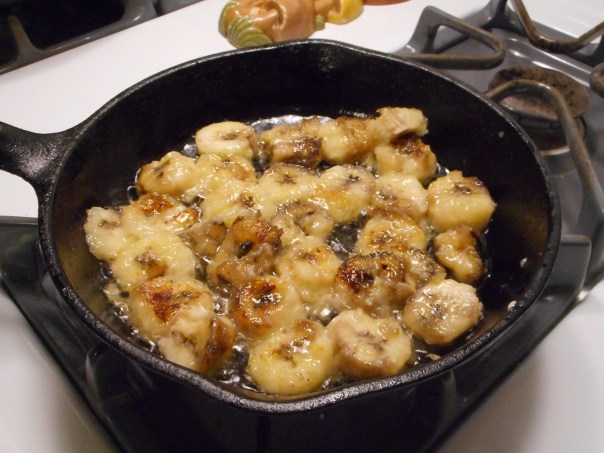
Continue to cook the banana slices for a few minutes until they start to emit a sweet buttery smell. Flip the slices over and continue cooking the other side for a few additional minutes. Less-ripe sections of the banana will remain firm, while the bruised sections become squashy–don’t be alarmed, this just adds to the texture of the dish as a whole.
Step 3:
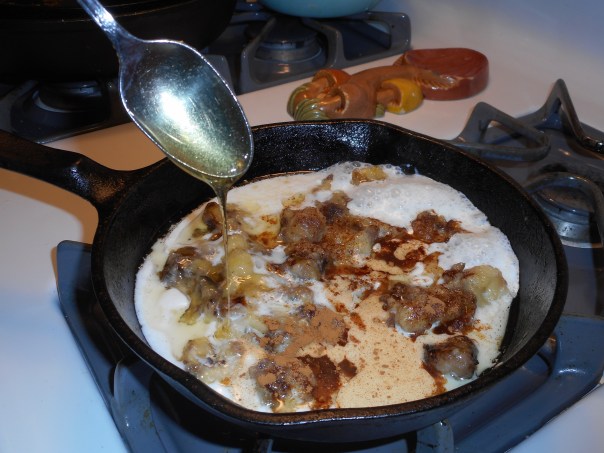
Add milk, honey, and cinnamon to the frying pan. With the skillet still on medium heat, add enough milk to form a shallow layer across the bottom of the pan. Drizzle in one spoonful of honey (as a sweetener–though the bananas naturally become sweeter as they are fried). Sprinkle in some cinnamon for spice. Heat the milk and continuing stirring until the milky mixture is reduced to the consistency of pancake batter.
*Note: substituting yogurt for milk eliminates the reduction process, but I used milk here because it is a frequent dumpster find.
Step 4:
Add in the coarsely chopped almonds (for both taste and texture). The resulting mixture now looks and tastes like banana muffin batter

Step 5:
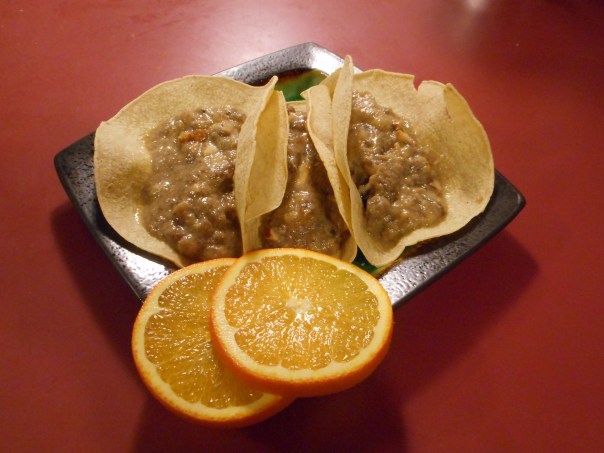
Spoon a generous amount of the banana mixture onto a 6″ corn tortilla. The resulting breakfast tacos are a sweet morning treat. Serve with a slice of dumpster-dived orange.

Aussie Bush Tucker
I’m venturing into the genre of culinary blogging! My first meal will be for some Australian Bush Tucker—in American speak, that means food from the Australian wilds. To make it authentic bush tucker, I foraged my ingredients from the wild bush* of Australia.
*by ‘wild bush’ I more accurately mean urban landscaping!
Appetizer: Macadamia Nuts
Macadamias are in fact native to Australia, growing wild around the eastern New South Wales/Queensland border. The macadamia also happens to be the only native Australian food that has a significant economic industry associated with it. Though my readers may be familiar with the food, they may not be familiar with how the nuts come to the table.

Macadamias nuts are, as expected, the nut of the Macadamia tree. The nuts grow in clusters on small evergreen trees, ripening in summer. The young nuts are enclosed in a green woody husk. As the nuts mature and dry, the husk will turn brown and split open and the husked nuts fall to the ground.
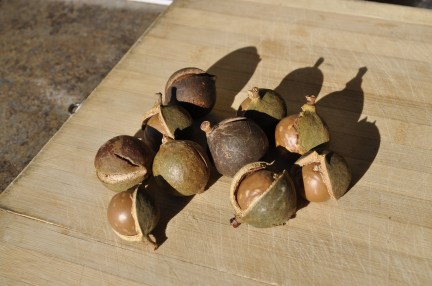
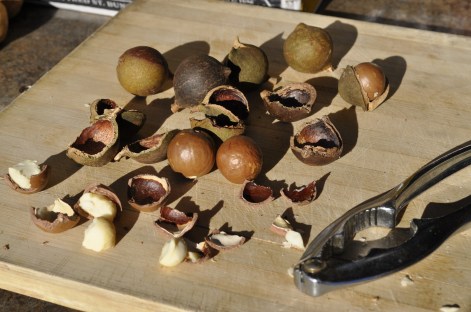
Eating Macadamias is fairly simple—or at least it should be! Though the dried husk is easy to remove, the rest of the Macadamia proves to be one tough nut to crack. Sad to say my humble nutcracker sacrificed its life in this meal endeavour. In cracking the nuts, the shells are able to sustain so much pressure that when they finally do crack, the nut shrapnel fragments fly everywhere. Any of the ivory-coloured kernel that can be recovered afterward has a most excellent tasting smooth and nutty flavour. Macadamias can be eaten raw, as I did, or prepared through other methods such as roasting or baking.
Main Course: Bunya Pine Nuts
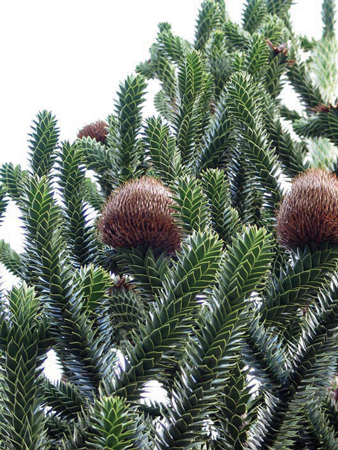
The Bunya Pine, though the name would imply otherwise, is not an actual pine. It is a more ancient form of conifer of the family Araucariaceae, which thrived in the time of dinosaurs but now is limited to a few species in the southern hemisphere.The Bunya Pine’s native range is restricted to Southeast Queensland, though they also are a widely-planted landscape tree. The trees grow to be tall and straight, with tough, spiky evergreen foliage. Better watch out when the Bunya Pine cones fall—they’re about the size of an adult’s head! Cockatoos also feed on the Bunya Pine nuts, opening the cones with their beaks and letting pine nuts fall to the ground.
The Bunya nut was extremely important as a food source for Aboriginal peoples, who would travel vast distances overland to reach the locations of Bunya pines to feast on the nuts. Great festivals would be held as neighbouring tribes set aside their differences to share in the feast. The Bunya nuts could be roasted over a fire or ground into a flour and baked into a bread.

I decided to boil my Bunya nuts. Though the nuts are protected by a tough, fibrous shell, the shell will soften and split upon either roasting or boiling.

I boiled my Bunya nuts for about 15 minutes, until the shells became soft and easily opened. The boiled water collected the tannin from the nuts, producing a dark, piney tea.

Opening the shell and getting the nut out proved to be a labour-intensive task (though considerably easier than cracking Macadamia nuts!) The shell splits along two seams, allowing a flap to be pulled back enough to allow the nut to be freed. The cooked nuts resemble giant garlic cloves, complete with the embryonic plant in the middle of the white endosperm. Eating the embryonic plant gives the most piney flavour. The startchy endosperm, in contrast, tastes akin to a potato—though instead of a smooth consistency, the nut is much more rubbery.

To supplement the little flavour in the Bunya Nuts, I doctored them up with cheese and salsa. Voila—an Australian meal of loaded Bunya Nuts. Similar to loaded baked potato, but a whole lot chewier.
 In All Directions