Category Archives: Nature

The Mud Puddle Ecosystem

Near where I live, an outbuilding was raised this summer. Down a gravel road then along a sandy two-track, the building stands new and distinct in a recent clearing in the woods. Earlier this summer construction vehicles often came and went, their heavy treads leaving a growing impression upon the sandy-clay soil. Spring rains had raised the water table and kept the soil saturated, making the soil easily molded by the tracks of heavy machinery. Every vehicular pass widened the quaint two-track until all the median vegetation was turned under and the ruts grew deep and muddy. Spring storms sent water flowing into the new depression; it was the genesis of a mud puddle.
I had walked past this puddle frequently during the summer. Always skirting around its edge, I never wanted to risk fully submerging my feet into the murky depths. Though it could feasibly be jumped across at places, it took fifty paces to walk entirely around. Getting too close to the edge was always risky. The waterlogged soil around the perimeter was slick and muddy; one careless step would result in a drenched shoe. Regardless, the dampness of the puddle oozed up into each visitor’s footwear, whether they were careful or not. How deep the puddle was I never found out. Its opaque muddy waters kept the true depth from me. There must be a bottom somewhere, but it was never for my pair of sneakers to find out where.
With the outbuilding having been finished, the rumble of construction traffic stopped mid-summer. The giant mud puddle remained, now undisturbed by track or tire. Only footprints troubled the new body of water. The hot July sun did its best to transform the lowly puddle into a series of dusty ruts, but continual summer storms provided aquatic sustenance. The puddle’s existence continued indefinitely.
A few weeks passed since the times I walked by the fledgling puddle in early summer. I remembered the puddle’s brown murkiness and the primordial look of its oozing mud. Yet, as I meandered past once again, I was drawn in closer. A sudden burst of movement caught the corner of my eye. Curiosity overcame me. In childlike wonder I stooped down to investigate what happened. A bullfrog had jumped into the mud shallows. Disturbed by my movement, the frog sought shelter in the puddle’s depths. The bullfrog now sat still, wary of any movement, its eyes poking just above the waterline. In my brief observational absence, the lowly mud wallow had been transformed. The lifeless ooze had changed into a thriving ecosystem all its own.
I continued to stand and watch closer. The longer I squatted and the stiller I stayed, the more movement caught my eye. Fat black blobs swam lazily in the brown water. These were tadpoles, the maturing progeny of the bullfrogs. Had the current generation of frogs been born in this puddle? Perhaps, but maybe the current bullfrog residents had moved in and lain their young there, staking the first pioneering claims to the new habitat. Elsewhere, more black dots darted quickly below the surface of the water, stopping as rapidly as they had started. With two long oar-like legs attached to an elliptical body, these are insects known as backswimmers. They have likely flown in from similar habitat in a nearby swamp. Aquatic predators, the backswimmers indicate the presence of prey species in the puddle, some of which are too small to see. In this short amount of time, a food chain has been developed in the puddle.
The formerly impenetrable murkiness of the water had also begun to clear. Slowly, sediment had settled and the opaque brown became semi-translucent. The water still appeared brown from the muddy bottom, but light now penetrated deeper down. Mats of algae now lay revealed floating in the water. Intricate, delicate; curvy, lacy folds of blue-green. Still waters had allowed algae to grow. Their spores—have they come from a proximal swamp? Were they blown in from afar? Had the spores lain dormant on the dusty road, just waiting for the rains to come again? Algal life now flourished in the mud puddle, serving as the primary producer—the energetic foundation of the new ecosystem. Elsewhere, blades of grass had started poking up from the mud. Likely remnants of the former median vegetation, the rhizomes of the grass had survived dormancy under the mud, now sending new shoots skyward to catch the sun. The inundation of the puddle had slowly decreased enough that lengthy miniature islands had begun appearing in the terrain. These new spots of land remained moist, the perfect germinating spot for colonizing plants. Ruderal species—common roadside weeds—had begun to sprout up around the puddle. In time, these plants will fill in the disturbed soil; the mud being inevitably covered up in a blanket of green.
Where had the abundance of this mud puddle even come from? Until recently, this stretch of road was a dry dirt two-track. Now, this simple mud puddle, along the lonesome two-track road, had turned into a sonata of life. It had grown into an ecosystem of its own right, a microcosm of all life itself. What will happen to the inhabitants of the mud puddle at the end of the summer? Will intermittent rains continue to feed its life? Or will the hot August sun desiccate the puddle and all creatures within? Next year, after a long and cold winter, will the puddle still remain? Or is it really just ephemeral, making only a brief temporal appearance when summer rains come down heavier than usual? In ecology, the process of change is continual. Entire ecosystems may come and go based on such a small thing as a depression to collect water. What will be the fate of the mud puddle ecosystem? Only time will tell.

Dragonfly Morning

Dragonfly eating a yellow jacket. (C) Bob Armstrong
The low morning sun breaks just over the distant trees. A direct sunbeam reaches the clearing below at the water’s edge. The air buzzes with creatures aflight, fresh sunshine glinting off lacy wings. I amble around the serene morning landscape. It is late spring. It is the morning of the dragonfly.
Days ago I watched these creatures emerge from the depths. Standing ankle-deep in a shallow stream, I crouched over a sunny rock. A nymphal dragonfly, mottled and brown to blend in with streambed gravels, crawled out of its watery home to the land above the surface. Stocky and strong, the size of a quarter, the nymph is the tank of the littoral zone. For months—even for years—the dragonfly nymph has patrolled the waters of its home. A voracious predator, it will seize any prey nearby into its strong maxillae. Powerfully the nymph shoots through the running stream with a water jet through its anus. Bloodworms are common prey, mosquito larvae too. Even tadpoles and minnows cannot escape the appetite of the mighty dragonfly nymph.
As of yet the nymph has known nothing of the land above the surface. Water has been its domain since it was an egg. Yet the dragonfly nymph is drawn by the biological imperative to crawl beyond. Out of the deep they will come, en masse in spring, then steadily during the summer. Squatting down, I watch the next generation of dragonflies emerge from the deep. Sunlight glints off the nymph’s still wet body; in a matter of minutes it will dry off completely. Pausing on a flat rock, the nymph looks dead and desiccated. Still, the nymph is fully alive; it soon reanimates, crawling onward towards its destination of the high brush.
Having completed its arduous landward journey, the dragonfly nymph clutches an emergent piece of grass. From here the nymphal stage has moved its last. The exoskeleton dries out even more. The nymph has died to the watery world, becoming nothing more than a mere mummified remnant. But inside the journey continues. Slowly, a weak suture line opens up along the back of the neck. The alien within the husk starts emerging. First the back bows out. Then the head pulls free. The creature arches its back, pulling out its legs one by one. One more arch of the thorax and the creature’s long abdomen is pulled from the husk of the nymph. Bright green and soft, the newly emerged dragonfly is exposed and vulnerable. Resting on top of its former exoskeleton, the dragonfly slowly hardens. The maverick of the air expands its wings for the first time in anticipation of flight. Hours later, the dragonfly is ready. It now joins the aerial display of other dragonflies humming above the disused nymphal exoskeletons still clinging to the bulrushes.
This morning I stand in amazement at the show before me. Hundreds of adult dragonflies going about dragonfly business. It is a harried, frenetic existence they live. The life in the air lasts but a few weeks, and much must be accomplished. Territory must be defended. Meals must be had. Mates must be found. Dragonfly business fills the morning stillness with an audible buzz. As in the water they are in the air—apex predators of the insect world. With voracious appetites they consume up to one-fifth their body mass in insects per day. Agile acrobats of the air, flying effortlessly in six directions—left, right, forward, backward, up, down. No insect prey stands a chance. The dragonfly’s keen compound eyes detect a world open to predation. Jerking forth in mid-air, the dragonfly snatches a housefly. It is time for a meal.
I crouch down to where the dragonfly has just landed on a narrow branch. It doesn’t seem to notice its inquisitive observer. Instead it’s just busy consuming its meal. The hapless fly is clasped in the dragonfly’s maxillae, its mandibles pull off the wings. The dragonfly then uses its rugged labrum to grind down the housefly into small pieces. Rotating the housefly around with its mandibles, the dragonfly’s meal resembles an apple being eaten. Minutes later, all evidence of the housefly’s existence is vanished—it has been integrated into the pulsating body of the dragonfly.
With a sudden jerk, the dragonfly launches itself in the air. It starts off as quickly as it had stopped. The dragonfly rejoins the hovering mass in the morning light, searching for its next meal. I watch in fascination; I can’t go on just yet. Though the dragonflies share in my presence, they remain indifferent. The spring generation has reached maturity and have bigger issues on their minds. Soon they will mate and lay their eggs back along the water’s edge where days ago they emerged. The spring influx of dragonflies will then dwindle. The aerial beasts will die and disappear. But the eggs have been laid and the mission completed. A year from now there will be more dragonfly mornings to come.

Do You Smell?

Do you smell?
The aromas of life surround you. Do you smell them?
What is it about an odor that can take us back, transport us somewhere different? A subliminal scent registers deep in the brain, evoking connotations of time and place. Do you remember those smells?
The pungent acridity of freshly cut grass and the distant earthy wafts of freshly spread manure arouse memories of a childhood spent in a suburban town encroaching into the countryside. My nose fondles the familiar scents as precious childhood souvenirs.
Wherever I am, the scent of a warm spring rain causes me to linger. That smell—that particular scent—is the essence of my aromatic association with home. The warm humidity of spring rains coat my nostrils, embracing them in a comfortable caress. The very sensation of humid air is far removed from the arid climes where I’ve spent the last three years. Nostalgia overtakes me whenever that sensation of the rain presents itself.
I was always told that the smell of spring rain comes from the worms. But the scent of worms alone could never do justice to the depth of the aroma. The scent is fundamentally deeper than that, nothing less than Petrichor—from the Greek words petra for rock and ichor for the blood of the gods. The fragrance of earth pours forth from the bedrock. The scent of spring rain is none less than the blood of the gods flowing through the ground.
The earth comes alive during spring rains. Soil microbes thrive in the warm, damp soils of spring, producing geosmin, the scent of the earth itself. Again a Greek construction, geosmin combines the words for the earth and the word for smell. Over winter the earth’s biotic community slackens its pace of life. Metabolic excrement accumulates in the soils, waiting to be flung into the air upon impact by rain. Spring rains re-awaken the soil microbes from winter dormancy, releasing even more of the distinctive geosmin fragrance. This is the smell of life emerging once again from the slumber of winter. Do you smell the very scent of life stirring?
I’m in the Boundary Waters Canoe Area right now. I’ve never been to this place before, but the scent brings me somewhere familiar. Is it the smell of the northwoods forests? Pine, spruce, fir, birch and aspen, all mixing their pheromones together in a melody of fragrance. Spring fecundity spreads through the air. Prolonged exposure to the scent of these northern forests registers deep in my mind. Yes, I have been here before. Not the Boundary Waters specifically, but to this place in general. The scent here is as much about where I am physically as about where I’ve been emotionally before. I ruminate with the old familiar smells. Comforting, inherently wild but familiar enough to feel homey and lived-in. Yes, I have smelled that before; yes, I have been here before.
The aromas of life surround you. Do you smell them?

Aussie Bush Tucker
I’m venturing into the genre of culinary blogging! My first meal will be for some Australian Bush Tucker—in American speak, that means food from the Australian wilds. To make it authentic bush tucker, I foraged my ingredients from the wild bush* of Australia.
*by ‘wild bush’ I more accurately mean urban landscaping!
Appetizer: Macadamia Nuts
Macadamias are in fact native to Australia, growing wild around the eastern New South Wales/Queensland border. The macadamia also happens to be the only native Australian food that has a significant economic industry associated with it. Though my readers may be familiar with the food, they may not be familiar with how the nuts come to the table.

Macadamias nuts are, as expected, the nut of the Macadamia tree. The nuts grow in clusters on small evergreen trees, ripening in summer. The young nuts are enclosed in a green woody husk. As the nuts mature and dry, the husk will turn brown and split open and the husked nuts fall to the ground.
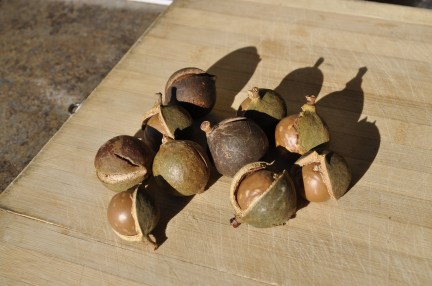
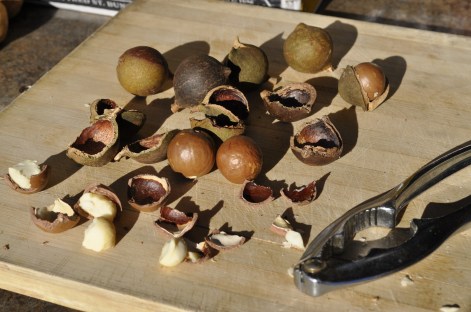
Eating Macadamias is fairly simple—or at least it should be! Though the dried husk is easy to remove, the rest of the Macadamia proves to be one tough nut to crack. Sad to say my humble nutcracker sacrificed its life in this meal endeavour. In cracking the nuts, the shells are able to sustain so much pressure that when they finally do crack, the nut shrapnel fragments fly everywhere. Any of the ivory-coloured kernel that can be recovered afterward has a most excellent tasting smooth and nutty flavour. Macadamias can be eaten raw, as I did, or prepared through other methods such as roasting or baking.
Main Course: Bunya Pine Nuts
The Bunya Pine, though the name would imply otherwise, is not an actual pine. It is a more ancient form of conifer of the family Araucariaceae, which thrived in the time of dinosaurs but now is limited to a few species in the southern hemisphere.The Bunya Pine’s native range is restricted to Southeast Queensland, though they also are a widely-planted landscape tree. The trees grow to be tall and straight, with tough, spiky evergreen foliage. Better watch out when the Bunya Pine cones fall—they’re about the size of an adult’s head! Cockatoos also feed on the Bunya Pine nuts, opening the cones with their beaks and letting pine nuts fall to the ground.
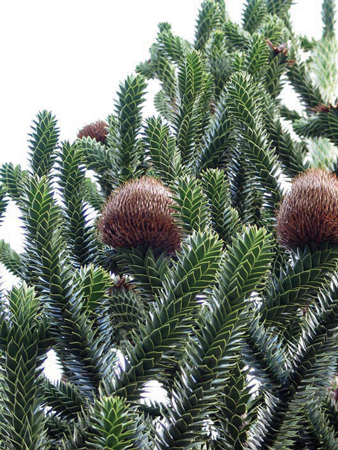
The Bunya nut was extremely important as a food source for Aboriginal peoples, who would travel vast distances overland to reach the locations of Bunya pines to feast on the nuts. Great festivals would be held as neighbouring tribes set aside their differences to share in the feast. The Bunya nuts could be roasted over a fire or ground into a flour and baked into a bread.

I decided to boil my Bunya nuts. Though the nuts are protected by a tough, fibrous shell, the shell will soften and split upon either roasting or boiling.

I boiled my Bunya nuts for about 15 minutes, until the shells became soft and easily opened. The boiled water collected the tannin from the nuts, producing a dark, piney tea.

Opening the shell and getting the nut out proved to be a labour-intensive task (though considerably easier than cracking Macadamia nuts!) The shell splits along two seams, allowing a flap to be pulled back enough to allow the nut to be freed. The cooked nuts resemble giant garlic cloves, complete with the embryonic plant in the middle of the white endosperm. Eating the embryonic plant gives the most piney flavour. The startchy endosperm, in contrast, tastes akin to a potato—though instead of a smooth consistency, the nut is much more rubbery.

To supplement the little flavour in the Bunya Nuts, I doctored them up with cheese and salsa. Voila—an Australian meal of loaded Bunya Nuts. Similar to loaded baked potato, but a whole lot chewier.

To Catch a Sunrise
I have a friend who grew up in Colorado. I listened with indignation one time as he described climbing mountains at midnight.
“But you can’t see anything!” I managed to sputter, expressing my contempt at the idea of hiking in the dark.
But, are all our experiences based upon sight alone? What else could be ‘seen’ in the dark when the ambient light grows dim?
The eye is truly an amazing organ, and sight is a sense unparalleled in constructing our world. Vision dominates the method of how we gain information about our world—by some estimates, over 80% of our information intake. As well, having sight is incredibly important to a hiker. Excuse the pun, but having vison helps a hiker see where they’re going. But with so much of our information intake dominated by our sense of sight, do we sometimes let other sensory input fall by the wayside?
With all my skepticism about the merits of a night hike, I recently commenced on a night hike of my own accord. My goal, of course, was still focused on vision—I was climbing the Tweed Range’s Mount Warning to catch some of the first rays of sun falling upon the Australian continent. After the initial chore of hiking a couple hours in complete darkness, I was expecting to be rewarded with a visual spectacle.
Strapping on my dim headlamp to serve as my guide, I was soon on my way. I stepped onto the trail and glanced about at the journey ahead. In the dusky glow of my headlamp, silhouettes of giant palms and tree ferns encircled me. Shadows danced about every time I swung my head. In the low levels of light, the foliage of the rainforest seemed ethereal, alive, almost magical. My standard sense of vision, I realized, was altered. Instead of seeing nothing, I was going to experience the world in a different light.
As I continued to climb in near darkness, I found my eyes drawn to any small source of light they could detect. In the absence of daylight, other sources of light make their presence known. Often I paused to gaze up at the stars, always shining, but obscured in the light of day. In the distance, I could see the twinkling glimmer of coastal towns, swaths of light in an otherwise dark world. Along trail cuts was the glow of bioluminescence—glowworms, hunting at night, producing their own light to attract unsuspecting insects. The bright light of daytime hides such treasures from us. It is the absence of daylight that draws our attention to them.
I found, too, that my other senses grew keener as my vision was reduced. I paid much more attention to sounds—the sound of the wind rustling through the leaves, the sound of a possum scurrying about. Smells were enhanced. I breathed in deeply the sultry tropical scents of the rainforest air. The humidity of the forest filled my nostrils and clung to my skin as I climbed in the night dew. Every brush of foliage against my arms came rightly to my attention. Things normally filtered out by my subconscious were now fully realized.
I summited Mount Warning in the dead of night, before any hints of lightness came over the horizon. I knew I’d have to wait for the expected visual show to arrive, but the show I experienced on my upward climb had made the whole trip already worthwhile. It turned out that a lack of sight had opened me up to many different avenues of experiencing the journey.
I stuck around to see the visual sunrise show. Waiting on the summit viewing platform for over two hours in the dark, my eyes became primed to see the subtle changes as the new day broke forth. I watched, riveted, as the sky slowly began to illuminate and go through its many moods and colors of dawn. At last the sun broke above the horizon, bathing the world in its fresh luminosity. I had successfully caught the sunrise. But that morning, I had caught so much more than just a sunrise.

Urban Nature
Sydney is a sprawling metropolis. But it’s also a beautiful city full of parks, greenspaces, and natural reserves. I find the interplay of the natural biological/ecological element in built-up environments fascinating. It’s a niche scientific field known as Urban Ecology, but I like to think of it more like Urban Nature. Here is a smattering of some natural sights I’ve been intrigued by around the city so far:
jfg
Let’s start out with the base…geology of course. Sydney is built upon a vast expanse of sandstone. Add the weathering action from the maritime climate, and this sandstone erodes into numerous cliffs that expose the natural patterning of the rock. Early Sydnians made use of the sandstone, using convict labor to carve steps into the soft rock and quarrying stone for Sydney’s elegant public buildings. (Images: grottos of eroded sandstone pockets; contrast of light rock and dark staining from running water; color patterning; color patterning)

jfg
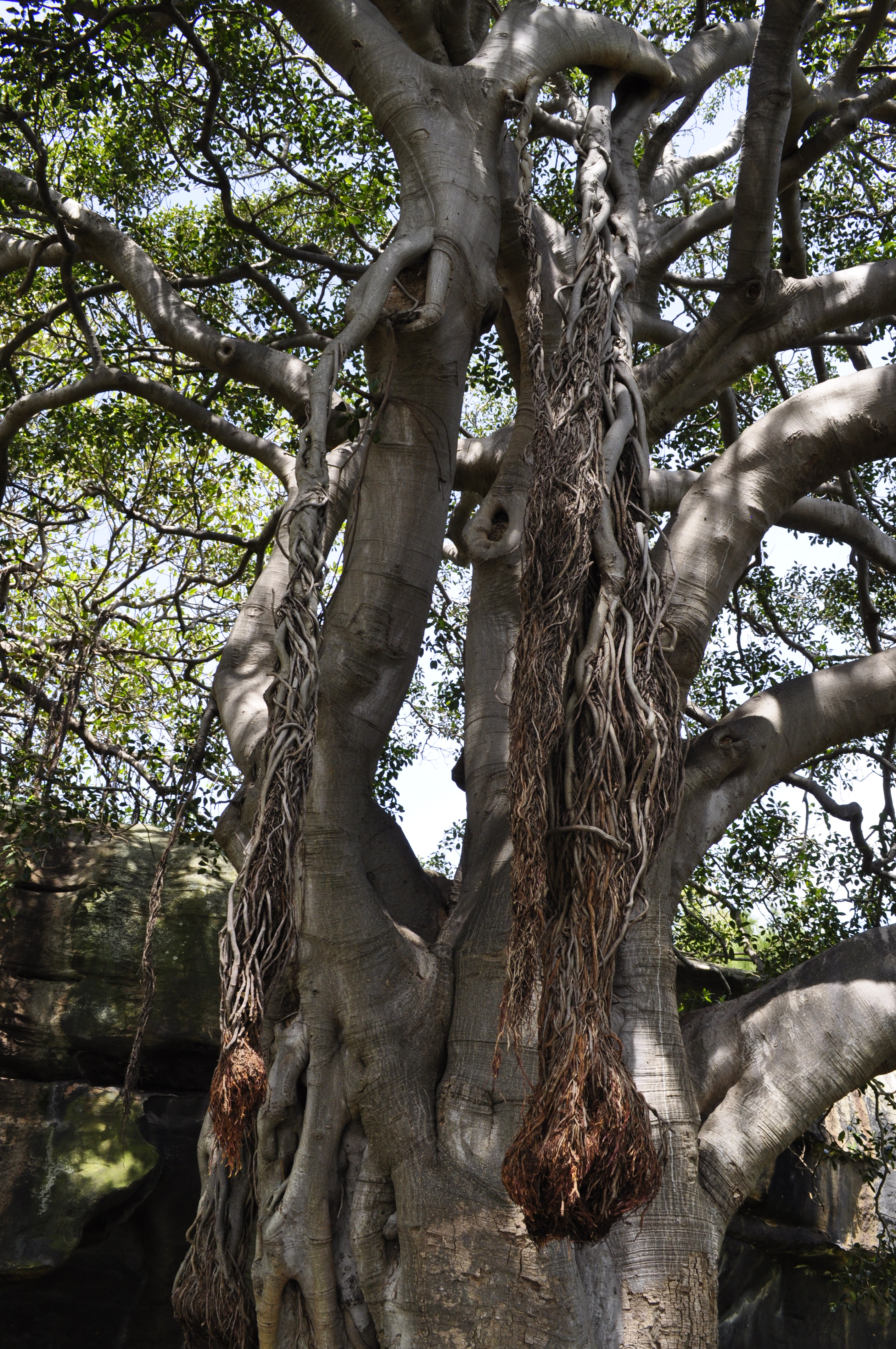
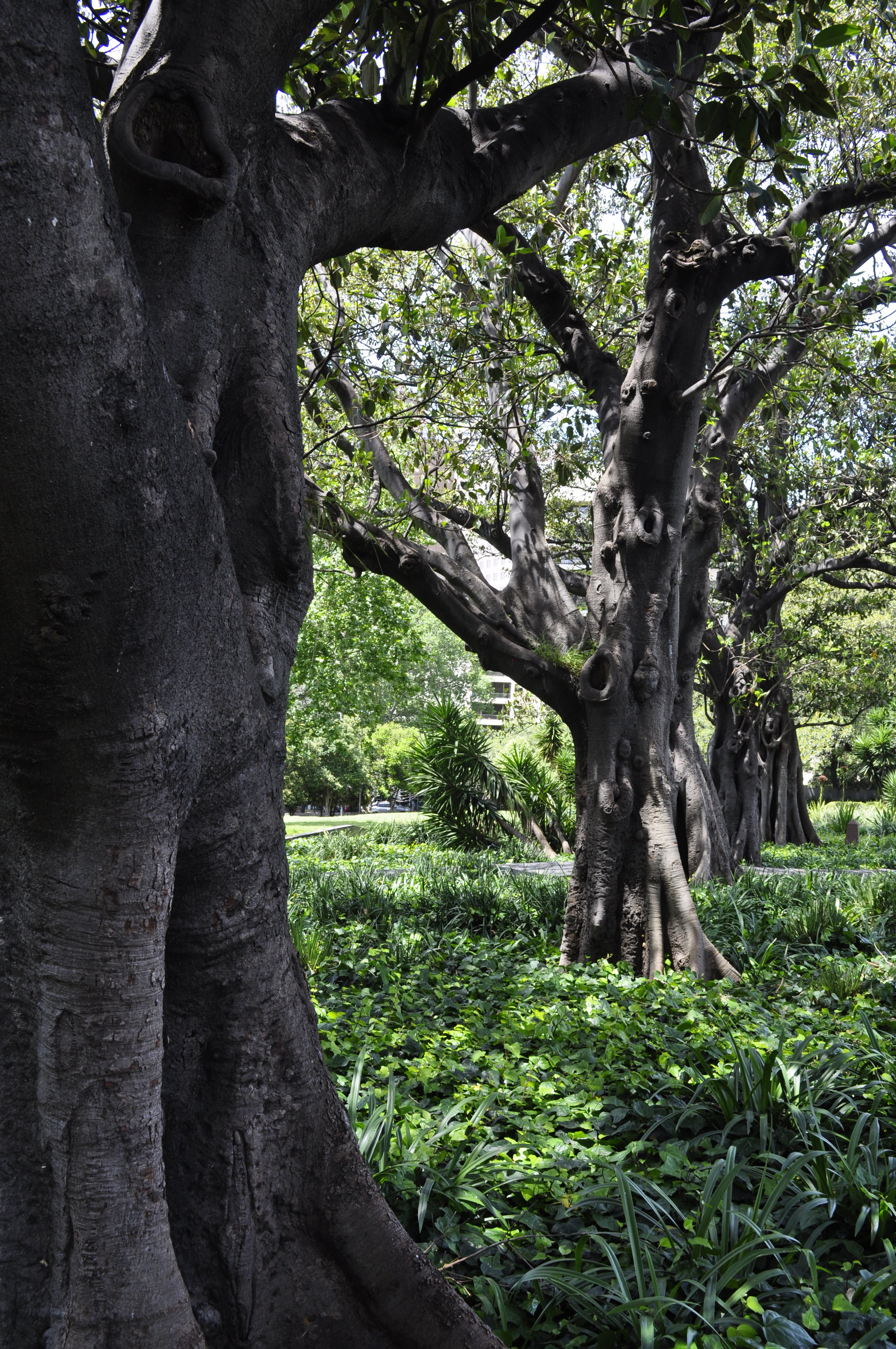
I wouldn’t be true to myself if I wasn’t fascinated by the new plants I’ve seen here. They may be cultivated as landscape plants, but their wild beauty exists nonetheless. (Images: Fig Tree growing mass of adventitious roots; succulents growing on sandstone cliffs; Jacaranda Tree in full purple blossom, row of unidentified trees in a park)

jfg
One can’t walk around an urban park in Sydney without seeing the ubiquitous Australian Ibis. With its long curved beak and bald black head, it’s a quite different looking bird than what is common in the States. Interestingly enough, the Ibis wasn’t common in urban areas until a series of droughts in the 70’s and 80’s pushed the Ibis into the cities. Though a species native to Australia, its decline in its native habitat and rapid increase in urban areas has led to questions as to whether it’s an endangered species or a pest.

jfg
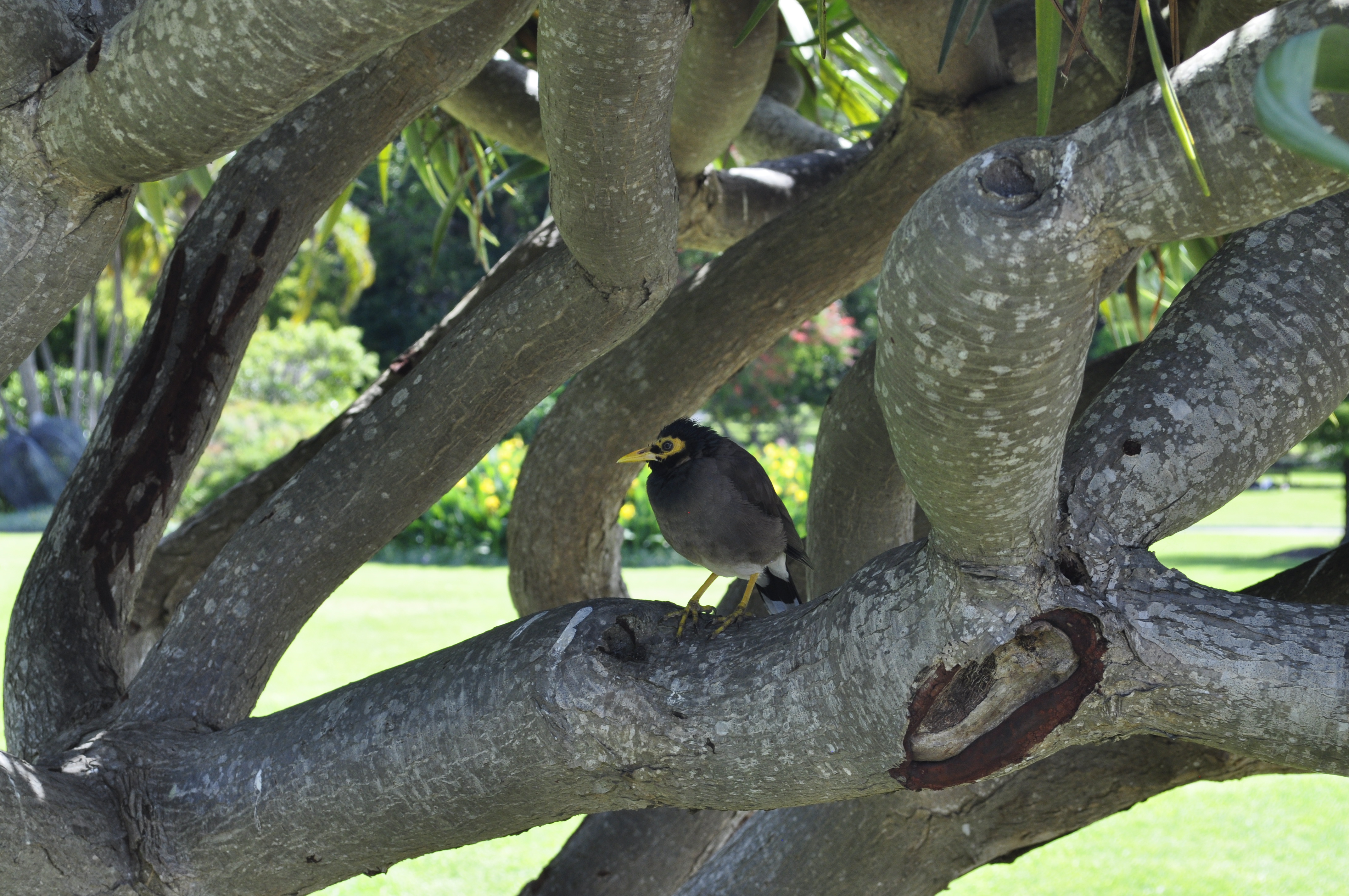
Another ubiquitous bird in the city is the Common Myna. Unlike the Ibis, the common myna is not native to Australia, and its status as a pest is unequivocal (it is recognized by the International Union for Conservation of Nature as one of the top 100 invasive species). The urban environment, however, provides the ideal habitat for these birds. Adapted to life as a scavenger in woodland environments, the features of a city—the abundant buildings for nesting, open sidewalks for foraging, and plentiful food scraps—provides an ideal home.
jfg
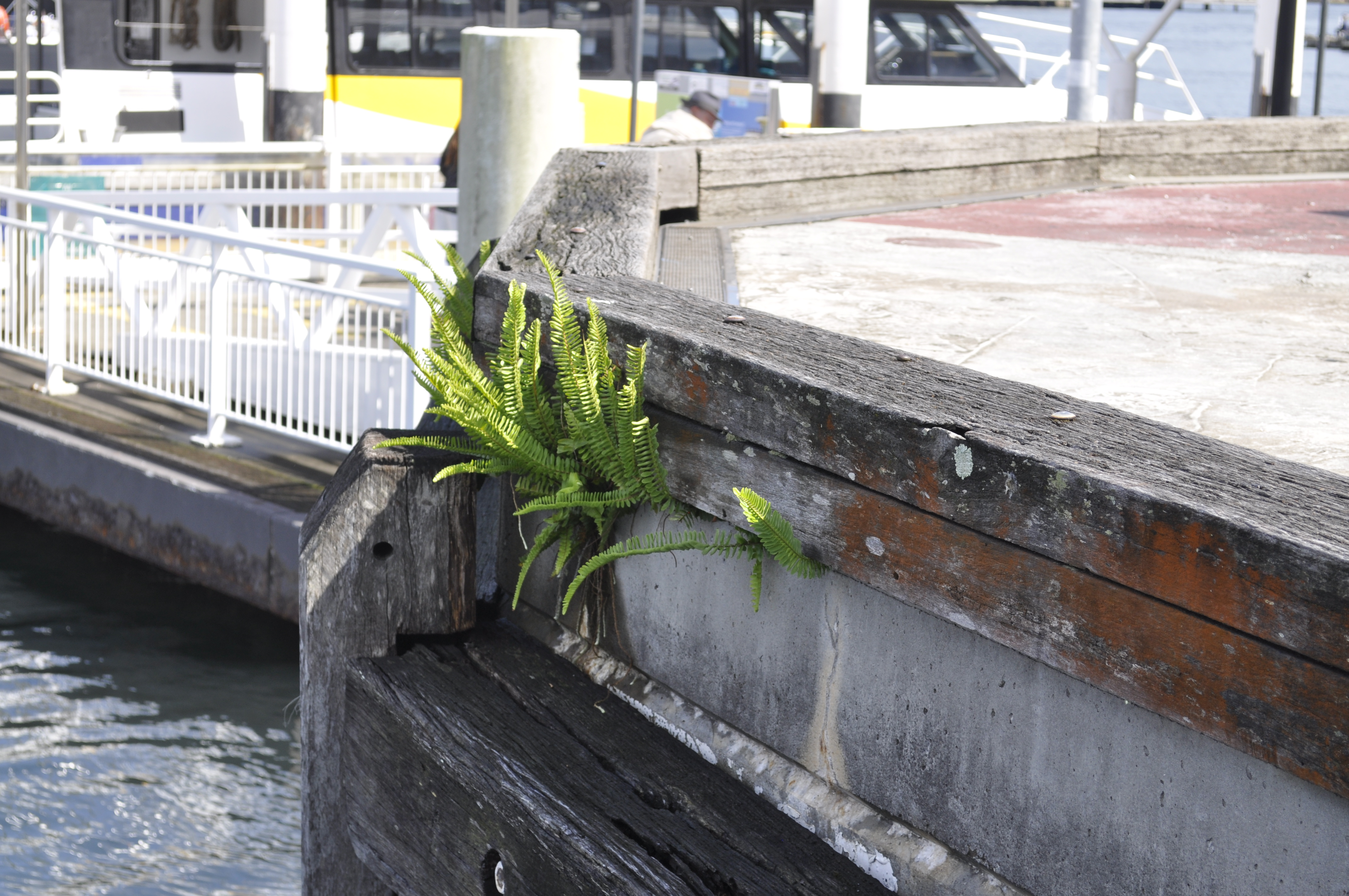
Ferns, being one of the most ancient types of plants, are able to thrive in harsh environments—both natural and urban. They grow wherever a crack in infrastructure provides a small foothold and traps enough moisture to drink. Here these ferns find a home similar to a sandstone cliff in the seaside dock and decaying brick wall.
 In All Directions