Category Archives: Wilderness

Confessions of a Trip Leader

The crew of the first trip I ever guided–a nine-day trip to Ontario’s Quetico wilderness
Getting paid to do what you love for a profession—an idea very appealing to a young, idealistic adventurer. We all have to work to earn a living anyway; might as well find a way to get paid for our passions. For myself, I really enjoy spending time in the outdoors, visiting wild places and traveling in the backcountry. Even if I held a conventional job I’d be doing these activities in my own free time. So, with an ample demand for outdoor guides in the recreation industry, why not become a guide and get paid to do my favorite pastime? Plus I’ve always enjoyed outdoor trips more when I’m with people to share it. Thus working as an outdoor guide seemed like an ideal position for me: I’d not only get to take people to spectacular places in the outdoors, I’d earn a livelihood from it as well.
I had entertained the fantasy of being an outdoor guide for a long time coming, basically ever since I went on my first guided trips and learned that guiding can be a profession. The outdoor guides leading me had always seemed to carry a certain aura to them: super-engaging, energetic, and adventurous. They got to spend so much of their time going out on trips or hanging out and goofing off at the outfitters. I perceived them as experienced gurus capable of surviving outdoors under any situation. They also seemed timeless—living eternally in the carefree moment of the trip and not caring about what happened before or what would come after a trip. Most important of all, they all seemed to be having fun no matter what. This was my preconceived notion of who outdoor guides were.
Now I’ve completed my first experience on the other side. Technically I have been a professional guide, since I received compensation for my guiding services. Yet it still feels really out of place and especially undeserved to consider myself a professional. I still feel like such an amateur, and so many of the skills required for the job I’m still developing. But as I’ve seen from employment, aside from the rudimentary outdoor skills needed to run a trip, a guide doesn’t need to be a technical gearhead at all. In my case at North Star Camp, I wasn’t hired for my technical skills—I was hired for my judgement and ability to relate to children. My guiding job was a whole lot more social than I expected; and perceptive social skills more so than advanced technical skills really make each outdoor trip memorable.
North Star Camp took the kind of people they wanted to hire and made guides out of them. Most trip leaders at North Star, like me, had very little canoeing experience prior to the summer; some had never even canoed before. But we all learned quickly. So many of the requisite technical skills of guiding can be trained in a short period of time. In my case, this included basic wilderness medical safety gained in an eight-day Wilderness First Responder Course followed by an intensive two week trip leader training conducted by North Star. All the trip leaders at North Star Camp this summer were first-time guides; our training consisted of an abundance of practical practice as we essentially scouted all of the trips we would be taking the campers out on. By the time the first campers had arrived for the summer, I had undergone nearly a month of training. By then I was more than ready to start guiding people. Adding campers to each trip just seemed like the next logical step—not much of a stretch at all.
However quickly technical outdoor skills can be taught, the parts of guiding that are most difficult to train are the interpersonal skills and social perceptiveness needed to effectively lead a group through the wilderness. The social aspect of the job can be touched upon during training, but so much of it is developing your own guiding personality from experiences gained on the job. Being an outdoor guide is quite like a big game of improv, a constant flux of evaluating the conditions and then adjusting plans based on a reading of group dynamics. Should we break for lunch here or there, now or later? Should we get to camp early or sleep in late? Does the group want free time or more structured activities? Aside from the generalized structure of a trip which details major trip checkpoints, a lot of events on the trip are still unknown even to the guide. Most of the time we’re just one step ahead of the group with our decisions, but we pretend we had an exact plan in mind the entire time. So much of guiding is just acting the part, looking confident and making decisions on the fly. Constantly we keep weighing multiple scenarios in our heads, evaluating which ones would benefit the group the most based on continually changing circumstances. Although before each trip goes out there is a lot of prep work in order to be adequately prepared, once you’re out in the field there’s a limited amount of control over the circumstances—everything else is just improvisation and making do with the conditions.

So much of being a guide is acting the part
Being an outdoor guide may have been the most fun job I’ve ever taken, but still it’s a job. Getting paid to take vacation after vacation is not the right idea for it. Sure, I’d be inclined to take personal outings to the places I led trips this summer. But when leading a trip as a guide the dynamic is entirely different than on a vacation with friends. Being a guide puts a lot of responsibility on you—you are the designated leader, the point-person for any mishaps that occur. Many guides are barely over 21, yet are entrusted with the health and safety of people venturing out into the backcountry—in my case, being entrusted with other people’s children. Perhaps some guides can give the air of being completely carefree, but the position actually requires constant vigilance to maintain the safety and well-being of all the participants.
Additionally, there are always the hum-drum tasks that are part of the guiding position. With so many trips coming and going, I was always in the process of unpacking the previous trip while outfitting for the next one. My guided trips were all of a similar nature, so I ended up doing lots of things over and over again: setting up tents, cooking campfire meals, doing camp dishes, loading and unloading gear, even paddling down the river could become mundane at times. Although a lot of these campcraft tasks are intrinsically enjoyable to me, doing these same tasks trip after trip for a job instead of for personal recreation turned some enjoyable tasks into a chore instead. On my own personal trips, I could do the same amount of work with hardly noticing, but when it’s part of the job description, unfortunately, it can feel more obligatory than self-initiated.
Even for as much work as a fun job like guiding can be, all the hard work seems worth it when the participants on your trip say they really enjoyed themselves. Leading trips may be your job, and you may have to go canoeing and camping on days you’re not feeling up to it. You may have even run this particular trip half a dozen times this summer already. But for the people you are leading, the days they are on a trip are something out of the ordinary. It is far different from the regular hum-drum of their daily lives. These participants come outdoors and notice the beauty of nature and appreciate the recreational activities with fresh eyes and happy expressions. It really makes my trip when I’m reminded of that.

A Canadian Coming of Age
“There is magic in the feel of a paddle and the movement of a canoe, a magic compounded of distance, adventure, solitude, and peace. The way of a canoe is the way of the wilderness and of a freedom almost forgotten. It is an antidote to insecurity, the open door to waterways of ages past and a way of life with profound and abiding satisfactions. When a man is part of his canoe, he is part of all that canoes have ever known”
-Sigurd F. Olson-
The Canadian. A non-specific phrase in its own right, but at North Star Camp for Boys, a phrase loaded with connotations of all caliber. At camp, talk of the Canadian points specifically to the many facets of one thing—it is the epic journey, a bildungsroman, a rite of passage unambiguously for the boys of North Star. Steeped in over 50 years of tradition, this outdoor trip to the wilderness of Ontario’s Quetico Provincial Park proves itself as an experience of a lifetime.
They have been looking up to the Canadian trip since they were first year campers—with apprehension, fear, wonder, amazement, longing. They have heard various tales and rumors about this trip from their friends, older brothers, or even their fathers who have completed the trip long before them. Successive cohorts of campers go on the trip and make their return, detailing the experience with tall tales and exaggerated truths. Each year spent at camp, the young boys see the Canadian trip getting closer and closer.
The Canadian is the culmination of North Star’s progressive outdoor tripping program. Every year at camp, the campers take a longer and more difficult outdoor trip. The youngest campers begin with an overnight canoe trip on a nearby docile river. River trips then become progressively longer and more technical as the campers mature developmentally. The year before their Canadian, campers trade in their canoes for packs and go on a hiking trip the length of five days and four nights. The following year, the Canadian trip more than doubles the amount of nights spent in the wilderness. Such an extensive experience is the Canadian that of an entire summer spent at camp, activities directly and indirectly related to the trip take up a quarter of the summer.
The mere thought of spending that much time out in the Quetico Wilderness proves intimidating to some of the boys. The mental and physical endurance required to complete the trip is much higher than any trip these boys have yet completed. Some doubt their abilities to complete the trip. Still, generation after generation of North Star campers handily complete the journey. It is a coming of age for all who undertake it. Though they are becoming young men, they are still a group of children; at only 14 or 15 year old, this is their last summer at camp as campers. The Canadian is the final transformational process in which these boys become men; a more tactile transformation than the symbolic coming of age of their Bar Mitzvahs only a couple years earlier. The transformation of the boys on the Canadian is one that they’ve earned through their hard work and endurance on the journey.
The Canadian, in a way, is a process of giving tangible hardship and practical challenge to a group of campers who face reduced adversity in their normal lives. Most campers attending North Star live in wealthy suburbs and come from privileged families who can afford to send their children to such a camp. North Star itself is not an outdoor camp either—it is a traditional residential summer camp with a tripping program only as one small component. Although every cabin group goes on an outdoor trip each summer, most campers do not come for the trips themselves. Though some boys love the trips, others can’t wait for them to be over.
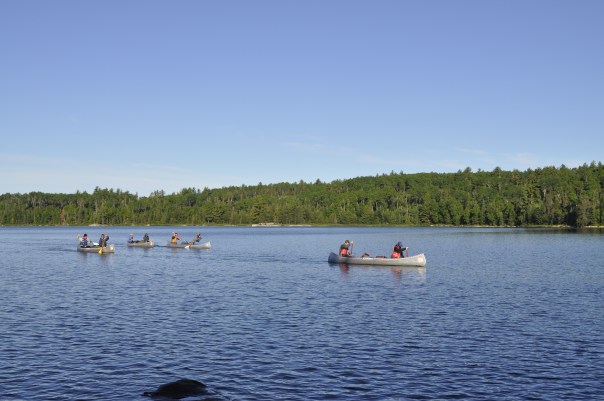
The Canadian, though always shrouded in mystique, was never anything more than the campers could handle. In fact, the challenge of Canada was substantially less than what it’s made to be. The gestalt of the journey may seem intimidating beforehand, but in reality the pilgrimage consists of nothing more than small obstacles to be overcome in the here and now. Looking back, the group of campers who I led should be proud of what they accomplished. Over the course of 9 days of wilderness travel, my camper group canoed over 105 miles and portaged the entire outfit over 7 miles in 22 separate portages. We faced variable weather, changing from intensely sunny and hot, to shivering cold and wet. Thunderstorms had us seeking emergency shelter off the lakes multiple times, and after storms on the second night soaked most of our gear, everything stayed damp with periodic rain and storms the remainder of the trip. We found strong headwinds could delay forward progress despite everyone’s strongest paddling, or a long muddy portage could take over three hours to complete and leave us pitching camp after 9 at night. Some nights dinner was freeze-dried lasagna unintentionally prepared as a soup, or our rations were reduced because of mice foraging in the food packs. My group even experienced an emergency seaplane evacuation of one of the campers on the second day.
The boys on my trip were thrown a lot of adversity, but the way they handled it was most indicative of their maturity. Though there was much to grumble about, there was little complaining out of sheer desire to complain. The tasks that needed doing were done, eventually with less prodding from me as the guide. Most importantly, a general good attitude was maintained throughout the duration of the trip. My camper group proved to me what maturing men they could be, and what they could handle in the circumstances. As well, the camper who was seaplane evacuated returned later to the group and finished the trip strong.
As an outsider to North Star’s 72 summers of tradition, I had to quickly learn the sheer importance of a trip like the Canadian. At pre-camp training, many of this year’s Counselors-in-Training (who were campers last year) said that their most proud accomplishment was completing the Canadian. At a Friday night ceremony with the entire camp staff later, when everyone was called to share a sentimental object, many more camper veterans brought objects associated with their Canadian journey. Even the camp’s program director, a North Star veteran of 30+ years, brought the souvenir of his first Canadian—a Loony Dollar—that he has kept tucked in his wallet since his first Canadian experience in the early 90’s. As a newcomer to North Star and as a first-year trip leader, I was honored to have the pleasure of being a guide for such a pivotal trip. As a guide, mine would be the responsibility of leading these boys safely through the wilderness and ensuring that they get the most out of their Canadian experience.
As much as the Canadian is a coming of age for the campers, the trip was a coming of age of my own. This Canadian trip was my induction into outdoor guiding, the first trip I ever led as a professional guide. Every trip experience before had been recreational and informal, either taken by myself or with my friends. For the first time, I was the officially responsible party for the safety and well-being of 12 children and two young adult counselors. I was tasked with making the trip a success and making sure the campers got the most out of their experience. Overall, my trip was an unqualified success. I surprised myself at how I could lead others in the wilderness just as much as the campers surprised themselves by completing their Canadian.

Saving Lives and Taking Names

The classroom is lined with bruised and bloodied students, oblivious of their apparent injuries, all sitting at attention ready to learn. Though the injuries may look severe or concerning (especially the occasional impaled object), everything here is purely superficial, the product of realistic special-effects make-up used in class scenarios. Although each student is cured of their ails at the end of each scenario, the special effects make-up stays on long afterwards, a constant reminder to the students about the nature of their studies.
This classroom scene is from a Wilderness First Responder (WFR) course. The WFR (verbalized as ‘Woofer’) students are here to learn the fundamentals of wilderness medicine. Over an intensive eight-day schedule, students go from learning about the critical systems of the human body to applying such knowledge in realistic scenarios of wilderness medical emergencies. The aim of the WFR course is to teach any interested person enough to be able to safely assess and evaluate any emergency situation and provide basic life support to each patient when in a wilderness setting—that is, when definitive medical care is at least two hours away. Medicine in the wilderness context is made more challenging by the lack of medical supplies and a setting that is often hostile to medical emergencies and the rescuers. Thus, WFR students are taught a holistic program of extended patient comfort and care in the wilderness and are encouraged to improvise tools from outdoor gear when medical devices are scarce.
A WFR course attracts an affable and often young group of similar-minded outdoor enthusiasts. Such personalities come with the terrain. Many enrolled in the course are burgeoning outdoor professionals—guides or instructors—but some also take the course for personal development. All share the general desire to help others in emergency situations in the wilderness. With a common interest in the outdoors and backcountry medicine, and with so much class-time spent together, a class group dynamic forms with its unique bond. Being comfortable with the other students in the course is essential too; as a very hands-on classroom setting, WFR students get close and personal in the process of learning: performing spinal palpations, simulating rescue breathing, backboarding, and much more. Having a WFR course taught at a roadless camp in the Boundary Waters Canoe Area also doesn’t hurt the sense of group formation. Classroom time is shared, but so are meals, lodging, and recreation time in this residential setting. The aura is one continually steeped in the learnings of backcountry medicine.
The WFR curriculum carries no pre-requisites. Class instruction takes the student from the ground-up and quickly builds upon newly acquired knowledge. Starting with the basics, students learn about the three critical life systems of the respiratory, circulatory, and neurologic systems in the patient primary assessment. A deficit in any of these three critical systems could entail death to the patient within minutes. Simple, early scenarios in the course cement the concepts of checking each patient for these critical systems to safeguard each life in immediate danger.
Once WFR students master the basics, they soon learn more about advanced topics—a wide variety of serious and not-so-serious medical conditions. Patients with intact critical systems get a thorough secondary assessment in the field that can uncover many other challenging problems. Discoveries made on the secondary patient assessment will lead to the decision of an urgent evacuation, non-urgent evacuation, or field treatment of the patient. A traumatically injured patient may soon go into shock and need to be evacuated immediately, whereas some simple joint dislocations can be reduced in the field allowing a trip to continue. All problems, from critical to superficial, become the territory of the well-trained WFR.
The apex of practical training in the WFR course comes towards the end, when students put their new skills and knowledge into practice in realistic full-scale simulations of medical emergencies. This is where the special-effects make-up really comes into play. The course instructor will set up a medical scenario in the woods—be it a storm during a canoe trip or a mass rock climbing fall—and use some students as patients. Student-patients get a list of injuries to act out in a scene; fake bruises and blood add to the realism. Other students in the course then serve as rescuers in the scenario, approaching student-patients with little prior knowledge of the scene. Using their newly acquired knowledge, student-rescuers need to perform patient assessments and treat injuries in the field as if it were a real emergency. Even after only eight days of training, the student-rescuers perform their job with a high degree of skill and knowledge. Mistakes are still made in these simulations, but class debriefings help both patients and rescuers understand what went well and what could be improved. Afterwards, student-patients and student-rescuers switch roles to practice additional medical scenarios. One can learn just as much about wilderness medicine by being a patient as by being a rescuer.
Certified WFRs are everywhere. We look just like any ordinary person. You may see us in a city or encounter us in the great outdoors. When the situation arises, we are trained and prepared for the emergency. And we may just be the ones who can save a life.
 In All Directions