Category Archives: Place

Home is Where the…(wherever)

The skyline of Hobart, Tasmania nestled between the sea and mountains
space
“This is the most beautiful place on earth. There are many such places. Every man, every woman, carries in heart and mind the image of the ideal place, known or unknown, actual or visionary. There’s no limit to the human capacity for the homing sentiment.”
-Edward Abbey, Desert Solitaire
space
One challenge for my time in Australia was to come up with a definition of what home means to me. The origin of this question goes further back, though, stemming from several protracted conversations with friends on the topics of home and place. As part of a generation coming of age in an increasingly globalized society, the question of home is no longer as limited as it used to be. Instead, rapid global travel and communication technology allow for a more mobile and connected society. Our options of where to live, work, and play quite literally span the globe. Yet, the idea of discerning one’s home in the vast world still constitutes a fundamental part of our identity.
As for myself, I feel like home could be anywhere. That’s to say that home isn’t necessarily a physical location in particular, but an idealized interaction with a location in general. Though I have travelled through admittedly very little of the world and have not experienced substantially different cultures, I can see a trend in my interaction to new places. Foreign locations become less foreign with familiarity. Given enough time, I feel that eventually I could make a home on any corner of the planet and be content with that location. This is not a judgement of place, but a judgement of my interaction with places. Home, then, is a process. It’s the homing sentiment.
Fundamentally, to me the question of home comes down to the concept of rootedness. How rooted do I feel to a certain place? My answer to that question is that I’m yearning to be rooted to any place at all. I struggle greatly through my travels with feelings of transiency and impermanence—essentially a new kind of homelessness. I yearn to be connected to a place at a more than superficial level, and any place could ultimately fill that desire. This is why, among other things, when I’m travelling I feel the need to stop at interpretive signs detailing local history—about the actions of city residents long dead or buildings long ago razed even though it may have little personal meaning to me at the moment. Doing such is just one small tangible way of discovering more about a place that leads me to a feeling of connection—that I belong more to a place now that I know more about it.
Given enough time, my habits of interaction with unfamiliar places should lead to a greater sense of home within each place I stop. Along with my habit of learning local history, I also tend to eschew corporate retailers in order to patronize businesses I could find nowhere else, take ambling walks along city streets to understand geographical differentiations within the city, and take note if I see local faces more than once. In short, in each new place I try to understand the local identity. I try to live like a local. This, fundamentally, is the reason why I feel like I could find sentiments of home in any geographical location.
However, though I feel like any geographical location could ultimately become a satisfactory home, some places I visit certainly seem more likely candidates. As someone who studies the natural environment and geography, the landscape—physical and cultural—plays an elevated role in the homefulness of a place. In my Australian travels, some places lend themselves more readily to sentiments of home; towns like Orange, Tumut, or Hobart sparked a sense of rootedness in me quickly. Other places, such as Maroochydore, felt reprehensible at first but inevitably grew on me endearingly. If nothing else, my period of meandering travel in Australia has helped me refine the qualities of a place that most readily resemble a home for me.
In a globalized society, the whole of the earth could theoretically be my home. Such possibilities create a world of geography to navigate in finding one’s place. For me, home is still an ongoing conversation, and I still have a lot of geography left to navigate.
***
‘I cannot honestly say that I liked Canberra very much; it was to me a place of exile; but I soon began to realize that the decision had been taken, that Canberra was and would continue to be the capital of the nation, and that it was therefore imperative to make it a worthy capital; something that the Australian people would come to admire and respect; something that would be a focal point for national pride and sentiment. Once I had converted myself to this faith, I became an apostle.’
-Former Prime Minister of Australia, Robert Menzies, reflecting on his changing attitudes towards Australia’s national capital Canberra.

Small Town Country Australia

A view down Wynard Street, the main commercial avenue in Tumut, New South Wales
I’ve been passing through a lot of small Australian towns lately. Ever since leaving the tourist haunts of the coast and travelling inland, I’ve been encountering a new Australian geography. Up through the Great Dividing Range mountains and onto the western plains, Australian towns get comfortably country.
From the New England Highway to the west side of the Snowy Mountains, I’ve passed through towns more familiar with the rumble of a livestock truck than to the stamp of tourist feet. Populations in these towns may reach from a few thousand to a few ten-thousand—not necessarily tiny by Australian standards. Regardless of their size, however, these towns may be the largest settlement for an hour in any direction—and thus these small country towns serve as regional centers of commerce. Along the backroads and byways of rural Australia, a traveller will be rewarded with the very appealing character of the Australian Country town.
My experience of country towns is based on one I’ve spent a fair amount of time in recently: Tumut, New South Wales. Tumut, like other country towns, lies amidst a landscape of grazing, field crops, orchards, and timberlands. Roughly halfway between the major metropolitan centers of Sydney and Melbourne, Tumut sits 30 minutes off the main highway—and is largely bypassed by the hubbub of interstate traffic. With a population of just over 6,000, Tumut is the principle settlement in Tumut-Shire, in addition to being the largest town for at least an hour’s drive. Though Tumut may be nestled in the scenic western foothills of Australia’s highest peaks, the Snowy Mountains, tourist traffic remains light here largely due to hilly terrain and narrow town access roads.
Small country Australian towns like Tumut share a distinct geographic feel. At the heart of these towns runs the main street, lined with the town’s oldest and most elaborate buildings. Wide brick sidewalks traverse either side of the main street with store-front balconies and branching European street trees providing shade from the blistering country sun. The most prominent buildings along the main street just might be the hotels—in Australia, hotels are the place you go to hang out and drink a beer. Even in the small town of Tumut, there are no fewer than six hotels along the main avenue of business: The Commercial, The Oriental, The Royal, The Star, The Woolpack, and The Wynard. Banks, shops, public buildings, and churches complete the line-up of edifices on the main street. Further out from the main street, historic brick and stucco houses speak of early city residents who had a great sense of pride and importance in the place where they lived.Though individual businesses may change through the years, the turn-of-the-century street façade remains strongly characteristic of the country town.
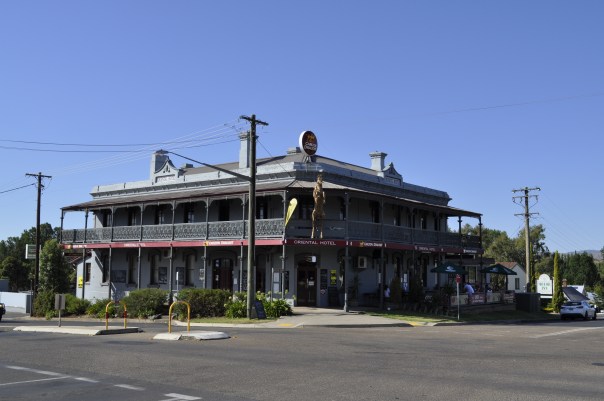
In Australia, you go have a drink at the hotel. Being common sights in country towns, hotels have a pub on the ground floor and accommodation upstairs. Large, sweeping verandas provide much needed shade from the Australian sun.

The School of Arts Building, built 1891. In small towns, the ‘School of Arts’ was established as both a repository of books and a community meeting hall–an early multi-purpose community building.
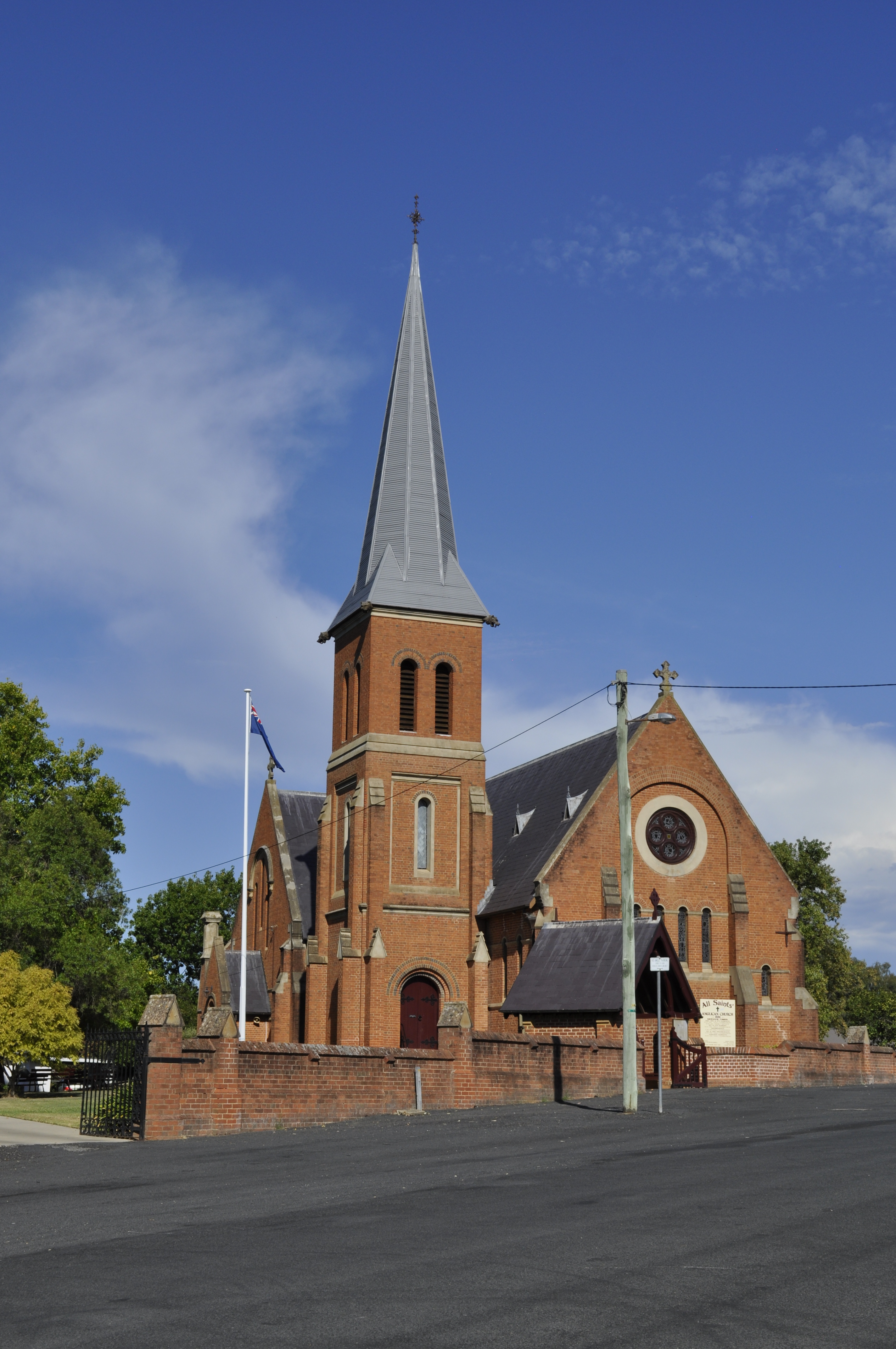
Elaborate churches add architectural character to the town’s built environment.
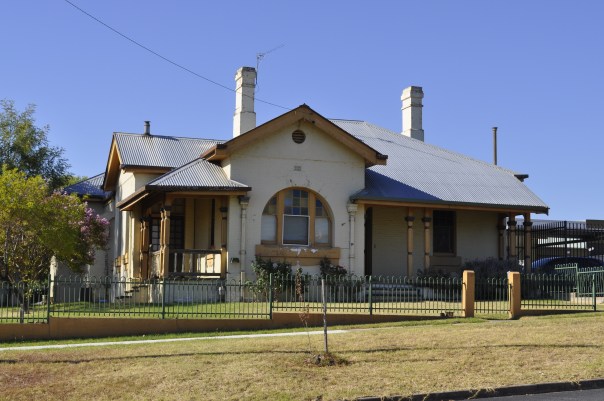
Turn-of-the-century brick and stucco house, with a characteristic tin roof.
Scattered around the business district and residential streets of the typical country town is ample parkland, which lends an appealing openness and naturalistic feeling to the rural development. These parks provide shade, recreational opportunities, and amenities to resident and visitor alike. As a visitor to a new town, I often form my quality assessment based on the town’s parkland and amenities—for example, public toilets and electric barbecues are very appreciated. Civic buildings such as libraries are another important public resource that attest to a quality of life in a town, in addition to being very helpful to the traveller.
The physical landscape—the built environment—is just one aspect that is characteristic of the Australian country town. The other aspect is the cultural landscape. Though I originally only planned to pass through Tumut on my search for employment elsewhere, I’ve ended up staying for a week now. Having found no job leads further afield, I returned to Tumut to come up with an alternative plan, and I have stayed because I enjoyed the aura of the city. I’ve found the people to be particularly friendly here, and more apt to start a conversation with the town’s new stranger. This is especially true while I’ve been sitting outside the library after hours bumming wifi for my job search. One local man came right up and joined me on the bench I was sitting on, talking to me as if we’d meet long before. He really only came to the library for some half-smoked cigarettes in the ash-tray, but he wanted to greet the stranger as well. He gave me some advice for my job search, and then informed me that in a town like this, everyone will know your business by the time you leave. I guess that’s all part of the small-town life.
My one week in Tumut has given me a good sense of the nature of the town, and may be a good indicator of the character of the other country towns I’ve passed through along the way. With little in the way of tourist traps in Tumut, I’ve been living like a local instead. Daily, downtown Tumut is a bustling locale—at the shops and bakeries by day, and at the hotels by night. I’ve nursed a beer at one of the hotels, listening to live music from a nearby bluegrass band. I’ve been shown the river float along the Tumut river where locals go to cool off on hot summer days. My van radio has been tuned to the local radio station playing golden oldies and old-time country music. I’ve eaten local produce fresh from the weekend outdoor market. I’ve even watched part of a high-school cricket match, and I’ve seen the civic pride of the Tumuters as a large group volunteered their Saturday to pick up rubbish in the riverside park. All these little things I’ve seen and done here in Tumut add to the congenial character of this small country town.
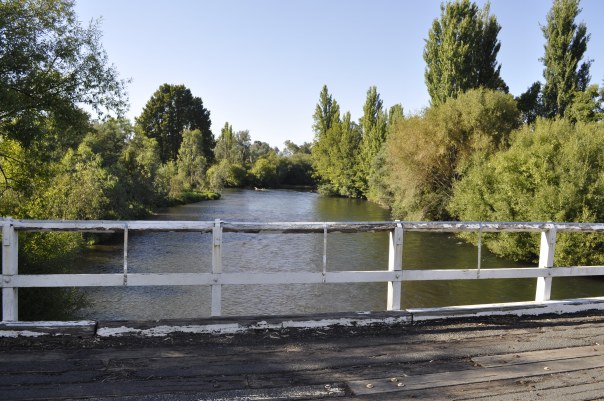
The Tumut River, as seen from the Old Town Bridge. The name Tumut is derived from an aboriginal word meaning ‘resting place by the river’. The river is a favourite local hangout.
It’s not that only small country towns have the kind of charm I’ve described—it’s that I find it easier to perceive in a small country town, where the bright lights of international corporate business and the McMansions of suburbia don’t obscure the local identity. Large towns, urban centers—these too have their unique geographies and contingent of dedicated citizens who make their homes resplendent with civic pride. These are the same people who pass the love of their city onto the wayward visitor.

A view of Tumut from the highest point in town, showing the foothills of the Snowy Mountains

Moving On…
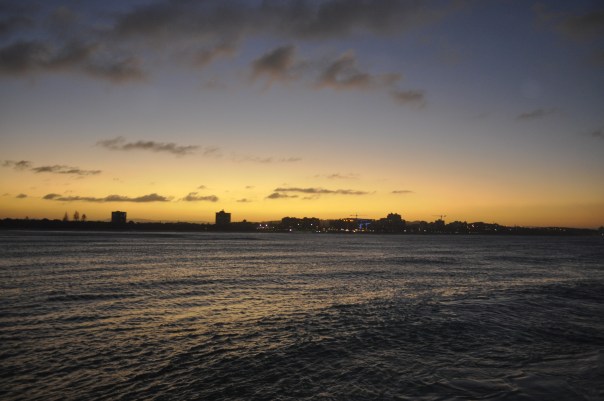
Sunset over the Sunshine Coast city of Mooloolaba
Tonight I sit reflectively on the spit as the sun sets, watching the distant foreshore of the Sunshine Coast as darkness falls and the city lights come on. Tonight is my last night here. Tomorrow I will move on.
Lychee harvest ended today. We had a celebration cookout under the veranda with all the workers, celebrating the achievements our labour accomplished. Afterwards we began our goodbyes to the crew we have known for a few short but intense weeks. “See you around,” say some as they leave the farm. “See you in Stanthorpe,” or “See you Tumbarumba” say others, gaily announcing their next planned destination, as if we expected to run into one another again. Joining the trend, I dismissed myself to the crew with “catch you in Batlow!”
But as I watch the sun set over the hinterland mountains, I contemplate why it is that I am moving on already. I didn’t even plan to be out here tonight—I had planned to stay inland to prepare for my upcoming departure. But something innate drove me to the coast. I just had to be here for one last night.
I have only been on the Sunshine Coast for a mere 31 days—longer than a visitor, but far short of being a local. I’ve just begun to know this strip of coastline and the lifestyle it affords. For a while, this place was my home. Why, I wonder sometimes, must I constantly be moving on right when I begin to know a place?
Australia, of course, is a different situation for me. Here I have no opportunity for permanency. I am no more than a long-term visitor, with a definite end-date for my time. My transiency is based out of the necessity of economics, continually chasing employment to support my holiday further. With immediate job opportunities on the Sunshine Coast having dried up, the promise of bountiful harvest labour now beckons me elsewhere. And too, I’ve created a busy itinerary for myself to see as much of Australia as I can—the breadth of my travels could not be reached if I do not continually move on. My own disinclination to linger beyond planned has left me a drifting traveller.
But I look onwards as the gleaming lights come on the high-rises above the beaches of Mooloolaba and Maroochydore. I wonder if I’d have the courage to deny my pre-conceived itinerary and continue to stay somewhere—merely because I enjoy the place. Would I brave enough to stop my relentless pursuit of places unknown (and potentially better) because here I have found something I’ve enjoyed?
I come from the generation sometimes characterized as ‘The Young and the Restless’. We move around easily from place to place, seeking localities suitable to our young, sociable lifestyles. No place is stayed at for too long if there is something better to be found. Myself, I always seem to be moving on from the places I have known out of a vital curiosity—an instinct—that there is something new, different, better out there to find. I feel convinced that if I stay too long in one place, I might not discover something else that fits me better. But I question my own logic. I’m too afraid to lose the illusory opportunity of something more promising that lies just beyond the world of the familiar.
I am one of a generation of cropped roots. Transiency describes my lifestyle, but I wonder why I always must be moving on.

The Beauty that Surrounds You
It’s a common question that gets asked when travelling.
“Where are you from?”
Answering the friendly chatter, you state where your home is.
“Ah,” muses the asker in polite conversation, “it must be beautiful there.”
As often as we hear this archetypal dialogue, we may not feel like the place we’ve come from is beautiful. But maybe it is. Maybe we ourselves just fail to see the everyday beauty that surrounds us in the places we come from.
As a traveler, visiting places for the first time, I am often struck by the beauty of the places I am venturing. It’s that initial shock—that sensation of something new and different being experienced—that gives the visceral feeling that this place is uniquely beautiful. The novelty of traveling to places unknown draws specific attention to the beauty held within.
In the five-week course of my Australian travels, I have repeatedly been struck by the beautiful landscapes I have seen, ranging from the inner wilds of Sydney itself to the untamed bush on the edge of civilization. Continually I’ve been awed by how different—and wild—and beautiful—it all seems. I feel like the people who live in Australia must daily be astonished by the beauty that surrounds them. How could where I come from even begin to compare?
After a pause, I answer the question posed by my fellow traveler.
“Yes, I suppose it is beautiful where I come from.”
Why do I seem to disvalue the place where I come from, as if all these other locales in the world are more scenic and more beautiful places to be? Is it perhaps the familiarity of where I come from which desensitizes me to the geography of my own homeland? For, where I come from is the known, the familiar, the common, the quotidian. The landscape of home becomes a daily occurrence, one that loses saliency in the day-to-day routine. As the backdrop of daily life, one’s homeland doesn’t seem to invoke that sense of witless awe or grandeur that one may experience travelling to a new place for the first time. In a sense, we don’t appreciate the magnificence of the places we come from to the degree that a traveler would.
But where I come from is beautiful. I know it. I can remember it. There are certain aspects of where I come from that I love—and I’ve come to realize how beautiful they are based on how I miss them. I long for that big lake I’ve known since childhood, that expanse of freshwater so vast that you can’t see across it. To this day, whenever I encounter a body of water I can’t see across, this feeling of nostalgia is invoked within me, reminding me of how beautiful that lake is to me. Similarly, a forest just doesn’t seem right unless it’s composed of northern hardwoods. For all the grandeur I’ve seen of the towering Coast Redwoods or the monumental Giant Sequoias, the prosaic humble hardwoods hold a spot in my heart—one of that comfortable embrace of a broadleaf canopy overhead. And the smells of the forests too—and the visceral sensations! That watery hug of the humidity on your skin on those sticky summer nights. That glorious smell after a fresh summer rain when the plants are green and the worms come out. The soothing sounds of crickets at night and the neurotic blinking of the fireflies. All these things about my home I’ve missed. These things are what home feels to me, and together they form a beautiful image in my mind. Sure, my homeland may not have the imposing majesty of Uluru-Kata Tjuta National Park, or the international status of the Great Barrier Reef, but it is beautiful nonetheless. It is the beauty of a place unique to itself.
Environmental historian Bill Cronon, in his profound but controversial essay “The Trouble with Wilderness,” reminds us that conservation starts at home. We need to start seeing the beauty—i.e. the wilderness—in the places we call home. Travelling to the wild and scenic fringes of the world may invoke in us a sense of grandeur worth protecting, but we need to learn from these sentiments and bring them home to value and protect the places we know as home—whether home is in the central city itself or in the uncouth fringes of the urbanized world. As Cronon puts it:(emphasis mine, and I’ve substituted the word ‘beauty’ for ‘wilderness/wildness’ as a synonym in two places)
“Wilderness [Beauty] gets us into trouble only if we imagine that this experience of wonder and otherness is limited to the remote corners of the planet, or that it somehow depends on pristine landscapes we ourselves do not inhabit. Nothing could be more misleading. The tree in the garden is in reality no less other, no less worthy of our wonder and respect, than the tree in an ancient forest that has never known an ax or a saw—even though the tree in the forest reflects a more intricate web of ecological relationships. The tree in the garden could easily have sprung from the same seed as the tree in the forest, and we can claim only its location and perhaps its form as our own. Both trees stand apart from us; both share our common world. The special power of the tree in the wilderness is to remind us of this fact. It can teach us to recognize the wildness [beauty] we did not see in the tree we planted in our own backyard. By seeing the otherness in that which is most unfamiliar, we can learn to see it too in that which at first seemed merely ordinary. If wilderness can do this—if it can help us perceive and respect a nature we had forgotten to recognize as natural—then it will become part of the solution to our environmental dilemmas rather than part of the problem.”
We need to learn—or maybe relearn—to appreciate the wonderful world that daily surrounds us. Travelling to the wild and pristine parts of the world can invoke the sense that such places are beautiful and worth our protection. But also, in seeing the innate beauty in a landscape that is so unfamiliar, we can learn to see again what is spectacular and worth protecting about the stage of our daily lives—a stage that sometimes seems to become just the merely ordinary. It doesn’t take a particularly observant eye to see the beauty in one’s surrounds; it just takes a perceptive mind to recognize it again when it becomes commonplace. I didn’t need to go to Australia to see beautiful landscapes—although admittedly it is much easier for me to sense it here. Instead, beauty abounded as well in the home I left behind.
Maybe sometimes we need to remind ourselves of the beauty that surrounds us. Maybe we should try and view the places we come from with the eyes of a traveler.
(Photo Note: Three Sisters Formation, Blue Mountains National Park, New South Wales, Australia)
The Cultural Exchange
I’m in Australia on what’s called a ‘Working Holiday’ visa. The working holiday visa program is a special arrangement between two countries that allows young residents (under 30) of one country to easily obtain a visa with working privileges to the other country. One of the goals of this visa program is to promote cultural exchange between the two participating nations by allowing up-and-coming youth to stay and work in a partner country for an extended period of time. I’m taking it as my homework to promote this cultural exchange between the United States and Australia. Though our cultures are very similar at first glance, I’ve come up with a list of things each country can learn from each other.
What the United States can learn from Australia:
- The advertised price is the price you pay. Taxes (i.e. the sales tax, or what’s called the GST General Service Tax in Australia) are included in the advertised price. No more hidden taxes or surprise charges at checkout time. It seems to be most fair that the price you see is the price you pay. As an American used to forking over just a little bit more cash when buying something, I still feel a little guilty at checkout, like I got away without paying for something.
- Get rid of the penny. I love the penny, but it’s time has come. Nowadays the penny is worth more in nostalgia than practicality. Whereas Americans enjoy advertising things for $X.99 and calculating taxes and transactions precisely down to the last penny, Australians are fine with rounding things to the nearest nickel. It’s easier that way, especially when taxes are already included in the advertised price.

Australian coinage, showcasing it’s unique fauna on the reverse sides of the coins
- Breakfast Cereal: America may be the envy of breakfast cereal variety, but the Australian cereal aisle was built for the health lover. No Froot Loops or Lucky Charms to be found in this country. Instead, Australia is famous for its health cereals, the more wheat and bran you can pack in the better. Most notable of all is Weet-Bix: the driest, most sawdust like breakfast biscuit ever engineered, but oh so tasty! Plus, in a feat of near-magic, a few Weet-Bix can absorb an entire bowl of milk.
.
Weet-Bix: “Every Aussie is raised a Weet-Bix Kid”
- Little cars and trucks can get the job done. You don’t need to make up for anything by driving a big truck. A compact van or flatbed sedan will work just fine to get the job done. Plus, compacts will help you maneuver into those tight Australian travel lanes. I’ve really been pleasantly surprised here in the city at how compact and efficient the vehicles are. No semi-trucks (at least in Sydney), and the biggest vehicle around is the size of an American mini-van.
What Australia can learn from the United States:
- Smoking is not healthy. So many people in Australia smoke compared to the States, and it’s not stigmatized as a lower-class activity either—in fact, most smokers seem to be wearing business casual. Whereas America has kicked its smokers to the curb, in Australia smokers have free range to roam—but as of recent they have to now be outside. Ashtrays aren’t really a thing here either. Throw your butts straight to the ground, and don’t worry because it’s someone’s job to sweep those butts up later. I would have thought that the cigarette cartons with lovely pictures of gangrenous limbs and mouth cancer would have been a deterrent to light up, but I guess not…
- Bike Culture: With terrain as flat as a Midwestern cornfield and weather as lovely as southern California, Sydney could be a biker’s paradise. Except that the bike culture is nearly non-existent here. As a biker, I’d be absolutely terrified to ride in the narrow, congested lanes of traffic—especially seeing how Sydney-ians drive. Though Sydney has converted some traffic lanes into really nice and safe bike lanes, no one seems to be using them. I’m thinking a big dose of Portland-style Bike Culture would provide the needed fix. It’s a two-way street though: the United States should take a cue from Australia and make bicycle helmet use mandatory.
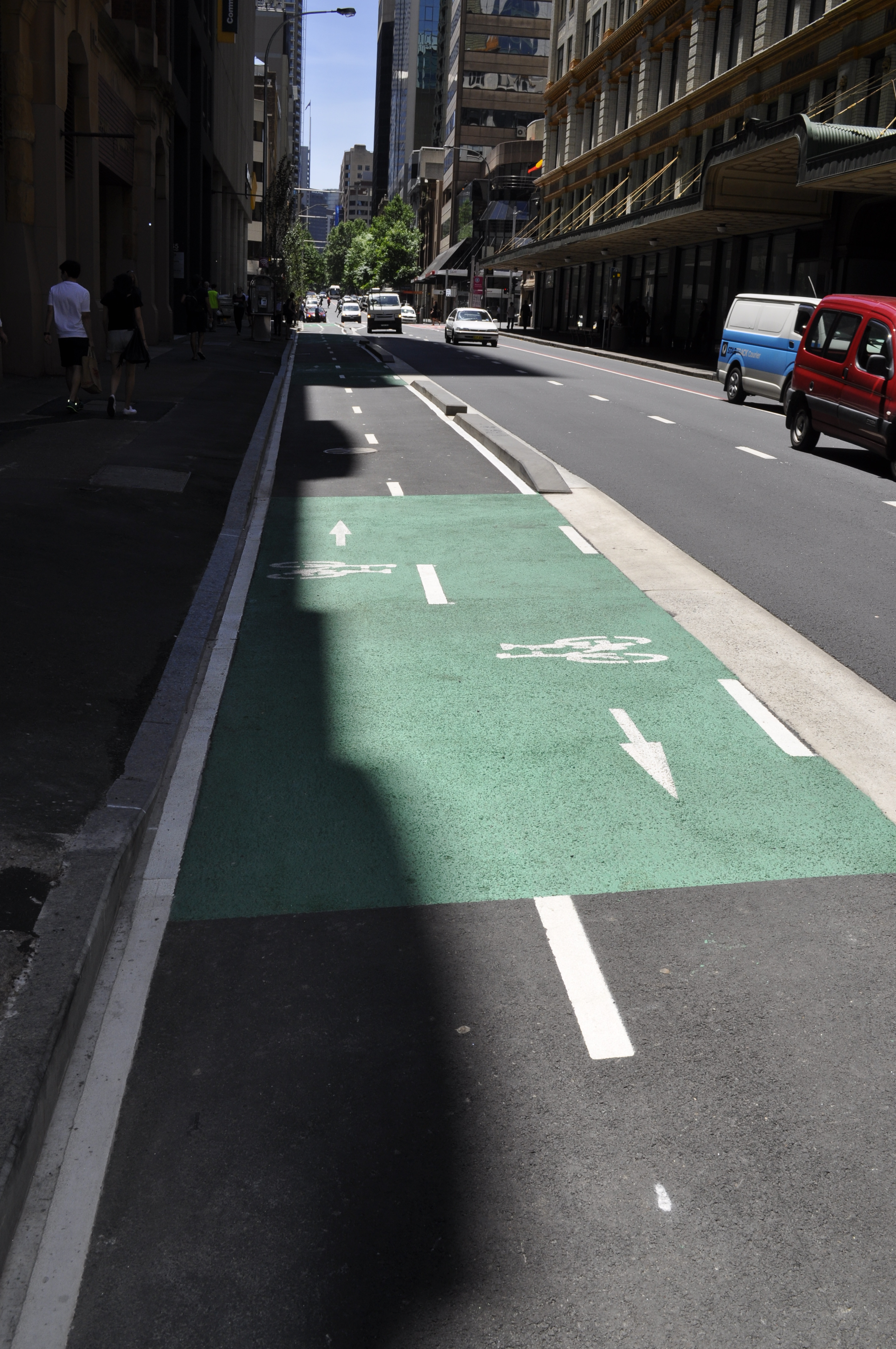
Bike infrastructure in Sydney: Great when it’s there—it’s just not there in many places.
- Raincoats: With a week of Seattle winter-like weather recently behind Sydney, I’m beginning to think that people in Australia don’t know what a raincoat is. Sure Australia may be the driest inhabited continent, but it still rains here. However, the preferred choice of rain-protection seems to be massive umbrellas instead of rain jackets. A rainy day in Sydney is a hazardous place for a tall person forced to navigate the sidewalks of bobbing umbrellas bustling at perfect head-height.
- Yellow Centerline Road Stripes: All road markings in Australia are done with white lines, as opposed to America’s system of using yellow lines to separate oncoming traffic and white lines to separate traffic travelling in the same direction. Although it seems like a small detail, this is probably the most important factor in why traffic on the left-hand side of the road hasn’t seemed odd to me. With only white markings, every street in the city looks like a one-way street. I suspect this might cause some troubles when I start driving in Australia later…
I’m still ambivalent about…
- The Walk Signals: Green Walking Man and Red Stopped Man. It makes somewhat more intuitive sense than other signals—unless you’re color blind. The jury is still out on which signal is optimal. But one thing for certain is that Australian walk signals seem to favor the flow of traffic. A walk down the street results in a fair amount of time stopped at the crosswalk waiting for the signal to change, even when cross-traffic is stopped as well.

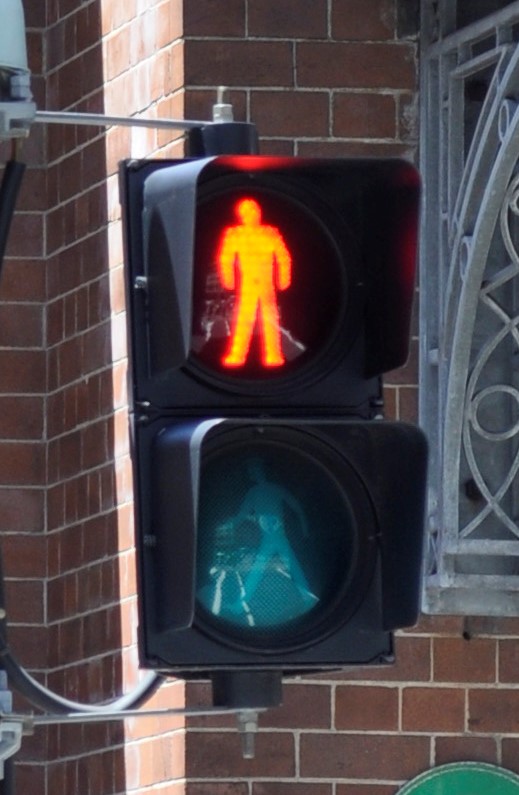
Walk. Don’t Walk.
- Australian Urinals: They are a floor-trough style with a waterfall flush. Fun to use, because it feels like I’m peeing on a wall of cascading water, but it definitely offers less privacy than single-user urinals. Also, although many urinals are flushed with reclaimed gray-water, the constant waterfall flushing still seems wasteful.
- Male and Female Toilets: The proper name of the room to relieve yourself here is the toilet—straightfoward, but less tactful than the American usage of ‘restroom’. Also, the gendered toilets are labeled by the biological sex of ‘male’ and ‘female’ instead of by the gender identities of ‘men’ and ‘women’. Biologically correct, but it seems out of sync with contemporary conversations about gender identity and restroom use.
 In All Directions