
Breakfast from a Dumpster
In all my years of dumpster diving, I’ve never been in a market quite as reliable as Grand Rapids. As a result, I always seem to have an odd abundance of usable dumpster-rescued food items that need to be eaten. As the diver never knows what treats lie in store each night, the contents of the magical mystery pantry often require creative thinking in order to prepare novel and tasty food dishes.
In this episode of Dumpster Kitchen, I tried to solve the problem of 120 corn tortillas and a bunch of (slightly bruised) organic bananas. A sweet breakfast treat seemed on hand…
Ty’s Creamy Banana Breakfast Tacos
Ingredient List:
- Oil
- Bananas*
- Milk
- Honey
- Cinnamon
- Almonds
- Corn Tortillas*
*Denotes dumpster-dived ingredients
Step 1:
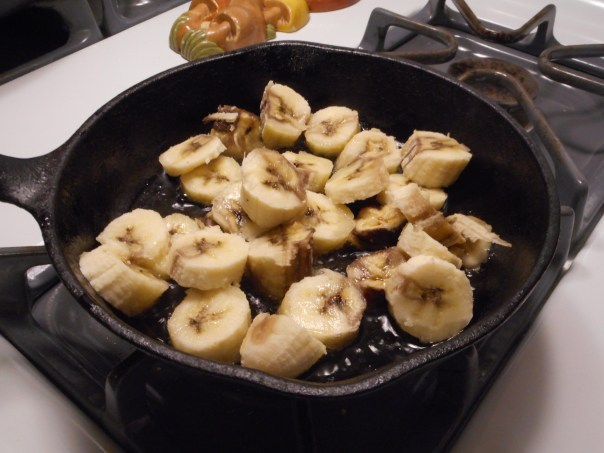
In a small skillet, pour enough oil to coat the bottom and turn to medium heat. Slice up the bananas into 1/4″ to 1/2″ slices and place in heated oil (I used vegetable oil). One small banana will fill one 6″ tortilla.
Step 2:
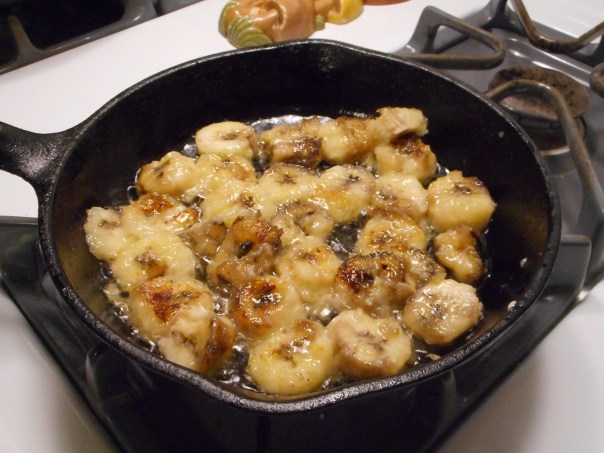
Continue to cook the banana slices for a few minutes until they start to emit a sweet buttery smell. Flip the slices over and continue cooking the other side for a few additional minutes. Less-ripe sections of the banana will remain firm, while the bruised sections become squashy–don’t be alarmed, this just adds to the texture of the dish as a whole.
Step 3:
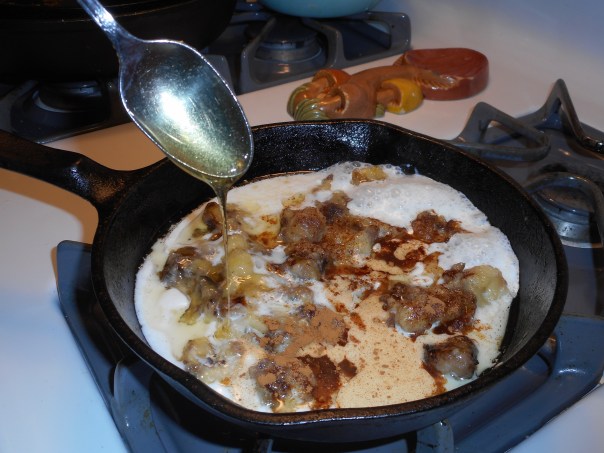
Add milk, honey, and cinnamon to the frying pan. With the skillet still on medium heat, add enough milk to form a shallow layer across the bottom of the pan. Drizzle in one spoonful of honey (as a sweetener–though the bananas naturally become sweeter as they are fried). Sprinkle in some cinnamon for spice. Heat the milk and continuing stirring until the milky mixture is reduced to the consistency of pancake batter.
*Note: substituting yogurt for milk eliminates the reduction process, but I used milk here because it is a frequent dumpster find.
Step 4:
Add in the coarsely chopped almonds (for both taste and texture). The resulting mixture now looks and tastes like banana muffin batter

Step 5:
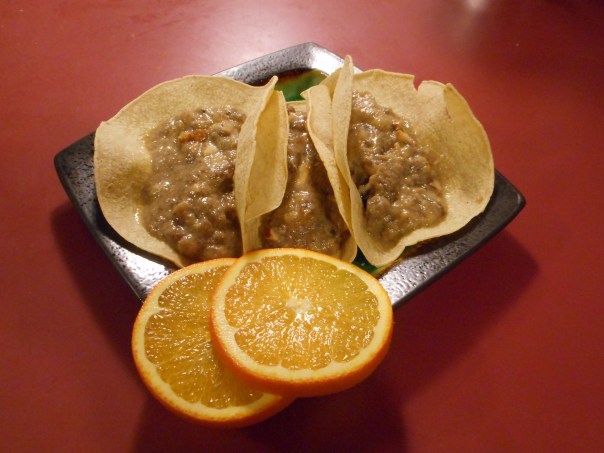
Spoon a generous amount of the banana mixture onto a 6″ corn tortilla. The resulting breakfast tacos are a sweet morning treat. Serve with a slice of dumpster-dived orange.

Back Where I Started
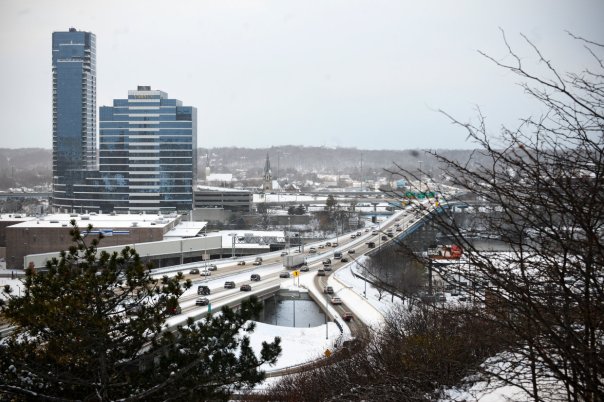
I just moved back to Grand Rapids. I haven’t lived in this city for nearly four years, since the time I graduated college. In those intervening years I’ve lived in three different states and one country, but I’ve also lived in Michigan at my parent’s place in Zeeland as well. Though I’ve been back to Grand Rapids on many occasions for visits, I’ve never had the reason to call the city home again. Now, after a length of time away exploring other places, I’m back where I started—the same location I was as a fresh college grad looking to get out and explore the world.
Coming back to Grand Rapids wasn’t all that unexpected. I grew up, after all, in the far-flung suburban town of Zeeland. In between grad school, jobs, and travel, I’d always make it back to the small town my family calls home, and then immediately I’d make plans to visit the big city. To me, there’s a big difference between living in the town I grew up in and living in the town where I came of age. In reality, the physical distance between Zeeland and Grand Rapids isn’t very great—I have, more than once, biked between the two cities. Instead, it’s my personal associations with the two cities that constitute the realm of difference. Zeeland, to me, recounts a place of dependence, of conservatism, of childishness. Grand Rapids is where I went to college—the location of my coming of age, of my emergence into adulthood. Grand Rapids was the geographical context in which I began to understand myself and to shape myself as an individual, breaking from the mold in which I was raised. As a result, my perceived intellectual gulf between Zeeland and Grand Rapids is now as wide as it was back in high school—when I believed Grand Rapids was so far away that it required an overnight stay to visit.
Though I am back living in Grand Rapids for the moment, I’m not back in town indefinitely. I’m even hesitant to say that my projected tenure in the city—a mere two months—really even constitutes moving back. Very soon I’ll be leaving town again for the latest stage in life exploration. But even though this current move is rather fleeting, it came with an intentional purpose: I had to get back to the environment where I found I have thrived.
Is it just the physical geography of the city that lures me back? Is it that I know the landscape, the street patterns, the stores, and the bus routes? Is it that my social network is still based primarily out of this city? That I still have friends and connections living here? Could it be my associations with the past that continually draw me back in? That I have become educated, made lifelong friends, and found my independence here?
Undoubtedly, it’s a little of all of these things. Michigan, my birth state, is the place I’m most familiar with. But the most formative years of young adulthood took place in a city different than where I grew up. On a psychological level, familiarity breeds liking. And it’s no doubt I cherish Michigan and Grand Rapids simply because I’ve spent so much time here. But my connection to the city is so much more than that.
In the years I’ve been gone from the city, life for its inhabitants has gone on like it necessarily does. The relics of my time here have largely been consumed in the metabolism of the city. New people inhabit the house I lived in. Different patrons frequent the spots I hung out in. Grand Rapids has continued to grow and change, and though the culture remains largely the same, the city I left upon graduation has drifted ever so imperceptibly in character. Friends that I had in the city have either moved away—or moved on. I myself—I can’t deny that I’ve changed as well. So much time travelling and having new experiences has shaped who I am. Though I’m returning, it’s a different person coming back to the city as well.
Despite all the differences, things are enough of the same. I still know my way around this city. I can still find the nearest grocery store and I can still make a living. I still even know a little bit about cultural events that go on here. And though I lament all those who have moved away and changed, I still have many friends in the city. I still have those residual social connections that I formed when I used to live here—connections formed from investments in the past. It’s a network found only here that I really just don’t have anywhere else.
Moving back to Grand Rapids temporarily as I am, I’m here to see returns on investments I’ve already made in the city. Unlike my past few years of constantly moving to new places where I have no connections made at all, I’m looking forward to living in a place where I have networks already in place. This was a conscious decision, after all. I needed to move back to a place where I wasn’t a stranger. I needed to be where I could see the benefits of my past involvements and also know that time spent is not spent in vain.
There’s something about the old wisdom that in order to realize how much you love a place, you need to leave it and return again. After my years away, I’ve found, as I suspected when I left, that someday I’d want to return again to Grand Rapids. And though my stay this time is only temporary, I rightly suspect that I’ll keep coming back to this city many times. To come, as it may be, back to where I started.

New Years Resolutions
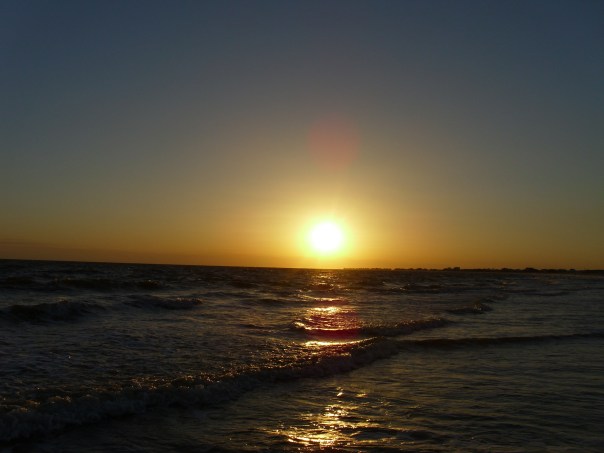
I didn’t make New Year’s resolutions for 2016. I haven’t started on New Year’s resolutions for 2017 either. Although I sometimes I do make resolutions for myself, it’s far from an annual tradition; whatever goals I do make tend to be more abstract and less definable in regards to their accomplishment. Previous resolutions of mine have included ‘being more spontaneous’ and ‘defying societal expectations’. To that extent, I have been slack in thinking of lofty goals for the upcoming year.
When midnight comes tonight, time will continue to pass just as it always has (disregarding the added leap second, necessarily). The infinite clock of universal time takes no notice of our mere Gregorian calendar and its arbitrary initiation of a new year. But for what tonight lacks in realness, it makes up greatly with symbolism—scribbling down a different digit when writing out the date could just be the needed break that some need to feel emboldened to make a change in their lives. Or, for those more cynical, waiting until the New Year is a great excuse to put off difficult change until later.
For me, I aim to live a life of continual improvement and thus don’t often use the method of making resolutions for a certain date in time. If change is to be had, ideally it should happen as soon as it is possible. Still, over the course of a year we do tend to stray from our ideals, and the prospect of a new calendar offers the chance to pause and reevaluate what kind of person we are and if that aligns with who we desire to be. If we’ve run astray of our intentions, the New Year might just be the catalyst to prompt the change.
But instead of focusing more on changes to come on the eve of 2017, I’d rather focus on what the outgoing year brought. Admittedly, I’d say 2016 was not my best year ever. The first half of the year saw the unraveling of my Australian adventure and with it the confidence that many of my ideas are not foolproof. Back at home, the health of some family members began to dramatically decline. Additionally, the downward spiral of American politics and the direction of the national discourse did not help in giving 2016 a good aura.
But 2016 had its peaks as well. For starters, I ended up traveling quite a lot, and to many new places. I also had the opportunity to try out a couple of jobs I’ve always wanted to try—leading outdoor trips and working on a wooden sailboat. This year was the one where I finally got a good taste of long-distance bike-riding and found I want even more of it. I even kept up my blog through the whole year. These experiences I’ve had, and many more, will be rooted in the year 2016; I’m grateful for 2016 because they happened.
And through it all, I’m grateful that I’m still well-adjusted and here to appreciate what happened. Making it to another year is not a given—it’s a gift and should be celebrated as such. Making it in good health and in good spirits is another thing to celebrate.
Thinking ahead to 2017, I don’t have many goals of what to do. Unlike 2016, 2017 will be less of a mystery upfront—I do, after all, already have my next two jobs lined up through October. I know I’ll be substitute teaching for a bit in Michigan before doing more environmental education in Massachusetts. The greater challenge of this New Year is instead what to be. Am I the kind of person I want to be? If I met myself as a stranger, would I want to interact with this person?
For me, the less frenetic pace of change upcoming in 2017 may lead to some more time for introspection than 2016 allowed for. A less uncertain lifestyle may also lead to the development of habits—either good or bad. Among habits, I’d love to meditate and do yoga more regularly. And 2017 will also present the challenges of existing within the changing context of our society. I foresee 2017 presenting challenges for tolerance and openness in civic life. As we look to our goals for the New Year, we can all look to ourselves and ask if we are the kind and generous and accepting people we would like to be; we can make a resolution to defy prejudice and stamp out hate.
Here’s to a better 2017
Happy New Year!

Winter Solstice

The land is quiet. The world is asleep. All around is still. No sound is heard save the lightly landing snow.
These are the short days of winter. Today is the darkest hour. The solstice is upon us; astrological winter has begun.
The world already knows the changes that have come. Plants lie dormant in the fields. Skeletons of last year’s growth remain as wind-battered sentinels above the white covering, an indicator of what species grew here in the warmer months. The animals, too, are hidden away; no tracks can be seen in the freshly fallen powder. Even the humans do not frequent these parts. The lone explorer presses along on skis, leaving behind an incriminating trail.

The winter sun vies for even a brief appearance through the clouds from its home low on the horizon. At these latitudes, it does not promise to linger long, if it even comes at all. Nevertheless, the fresh blanket of white reflects what little sunshine penetrates through the overcast skies. Beneath a firmament of gray, the land shines brilliantly bright. Such brilliance comes at the cost of the absorption of solar energy; the positive feedback cycle of winter cold is nearing its zenith, not to be broken until the sun shines more directly overhead once again.
Today the air is frigid. The illimitable cold turns the flakes falling from the sky light and airy. Super-frozen, they land delicately on the ground in a cottony pile. The lightest motion stirs up the powder like a coating of fine dust. Pick some up in your hand; you can blow the crystals of frozen water cleanly away. Taste some of the snowflakes; they melt instantly in your mouth.
Everywhere, the snow piles up. On tree branches, the fresh flakes land on top of one another in an acrobatic perch. The mere gravitational weight of the snowflakes causes them to deform, slowly melding the flakes together into a structural form. The smooth coating of white on everything makes the world look soft and inviting—comically rotund, perhaps—and radiantly white. How long has it been since movement disturbed these branches?

Though it is well below freezing, the small stream in the field remains unfrozen. The energy inherent in the motion of the water keeps the stream from solidifying, though snow flows in the water and ice nips at the edges. This creeping ice foreshadows the inevitable reach of the cold. It too, wants to cover over the stream, to cease even the motion of the water. For now, the water still flows. Water, in every state, is still flowing.
Nearby a chickadee flits around in the bushes. Now clothed in tones of dull gray, this year-round inhabitant matches the pale hue of the surrounding woods. The chickadee braces for the cold dark days of winter. It must vigilantly search for the stashes of seeds it has cached in the summer. Inactivity can quickly lead to a songbird’s demise.
The chickadee flies away just as quickly as it came. The world is once again still. No moving dares disrupt the hushed world. It is a time of waiting. Winter is here.

Photographs taken in Zeeland, Michigan

The Land of the Free (Museums)

I’ve recently spent a week in our nation’s capital, Washington D.C., touring the important sites and institutions that run the country. In terms of educational vacation destinations, Washington D.C. is ideal because most of its signature attractions are free of charge. While I visited America’s capital city, I also learned a lot of interesting and obscure facts about our country:
*The nation’s premier museum institution, the Smithsonian, is an oddity in itself. The founding benefactor, James Smithson, was a British chemist and mineralogist who never once set foot in the United States. In his will, Smithson wrote a stipulation that if his only nephew should die childless, Smithson’s entire fortune should be gifted to the United States government as “an establishment for the increase and diffusion of knowledge among men.” Smithson’s nephew died a boy in 1835 and the fledgling United States government shipped Smithson’s fortune in gold coins from overseas to begin the Smithsonian Institution.
*Looking for a unique gift this Christmas? The largest book in the Library of Congress is Bhutan: A Visual Odyssey Across the Last Himalayan Kingdom, written by Michael Hawley. It is a 5 foot by 7 foot photographic exposition of the country. (Library of Congress)
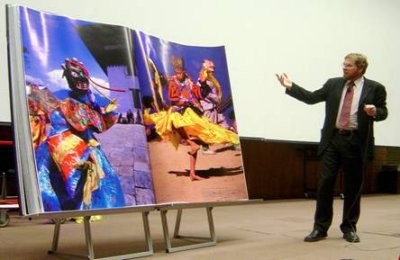
The Massive Photo Book ‘Bhutan’
*The 1980’s saw a tremendous explosion in the diversity of Poinsettia colors. Horticulturalists used radiation to induce genetic mutations and cause colors other than the standard red and white to be produced. (National Botanical Garden)
*As president Abraham Lincoln said, “the best way to predict the future is to invent it.” Lincoln was true to his adage by being the only US president to ever hold a patent. Lincoln’s invention, patent number 6469, was an inflatable apparatus under the hull of ferry boats that was intended to buoy boats over shallow channels. Unfortunately, Lincoln did not quite invent the future as his creation proved impractical and was never manufactured. (Smithsonian Museum of American History)

Abraham Lincoln is memorialized for things other than his inventions
*Though typically thought of as an instrument of white Appalachia, the banjo owes its origins to African Americans. African slaves who were brought to America in the 1700’s fashioned a stringed banjo-like instrument out of a hollow gourd similar to an instrument in their homelands. Their instrument later evolved into the banjo form we recognize today as it became popular in white minstrel shows and in American folk music. (Smithsonian National African American History Museum)
*When the Senate Wing of the United States Capitol was completed in 1859, Senate vacated its old chamber. Filling the vacancy for seven years afterwards was a pop-up farmers market complete with livestock in the old senate chamber. Back in the late 1800’s, building security was not as tight as it is now, but some still consider the capitol to be full of swine. (United States Capitol)
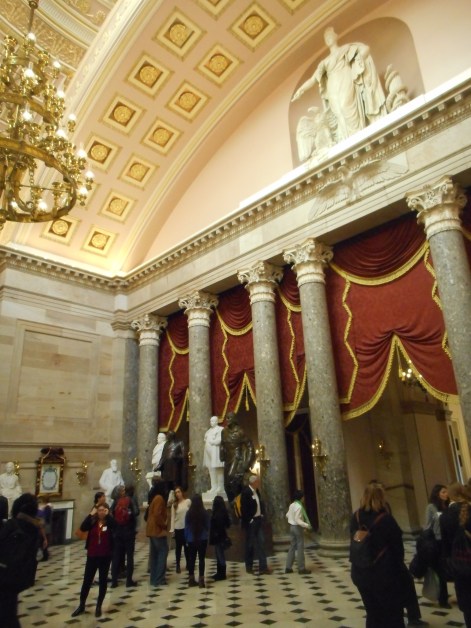
The old Senate Chamber, where the one-time market took place, is now a statue hall.
*The hot air balloon’s early history is tied intimately with military use. Hot air balloons were used for spying efforts in the French Revolution and by the Union in the American Civil war. (Smithsonian National Air and Space Museum)
*Could you have an antique form of American currency lying in your wallet? For the greater part of the 20th century, the United States government produced three types of bills which circulated as legal tender paper money. The currencies—Federal Reserve Notes (current), United States Notes (until 1996), and Silver Certificates (until 1968)—were of visually similar design but had different legal implications. Today, all bills produced are Federal Reserve Notes, but that doesn’t mean the older types don’t show up now and then. As I now know, the odd blue-tinted dollar I kept in my wallet during high school was actually a silver certificate, which would has been redeemable for one dollar worth of silver…until I unintentionally spent it. (United States Bureau of Engraving and Printing)
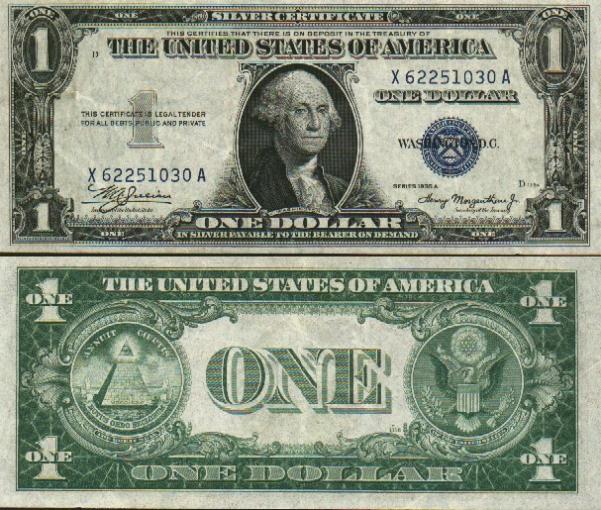
It’s not a Dollar Bill…it’s a Silver Certificate!
*Wood is a renewable building material that is gaining interest for large scale building projects. The city of Springfield, Oregon, is planning on building a 4-story, 350-car parking garage completely out of wood. (National Building Museum)
*Though the Washington Monument is made up of 555 feet of stone, the very top of the obelisk is a small capstone of aluminum. When the monument was completed in 1884, aluminum was more costly than silver or gold due to the price of electricity needed to produce it. (Washington Monument)
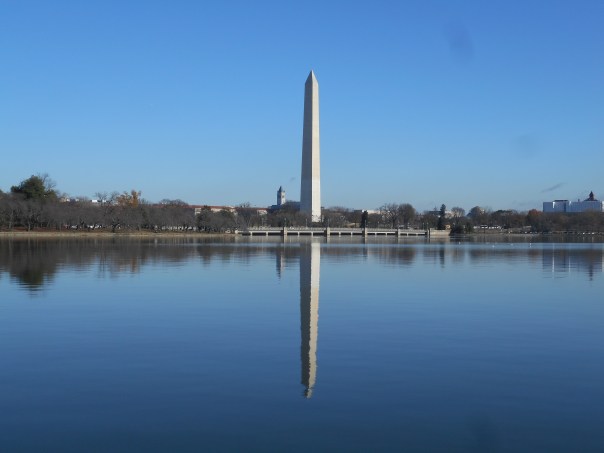
Washington’s Monument reflecting on the lagoon

Thoughts from Silverstein Family Park, Downtown Manhattan

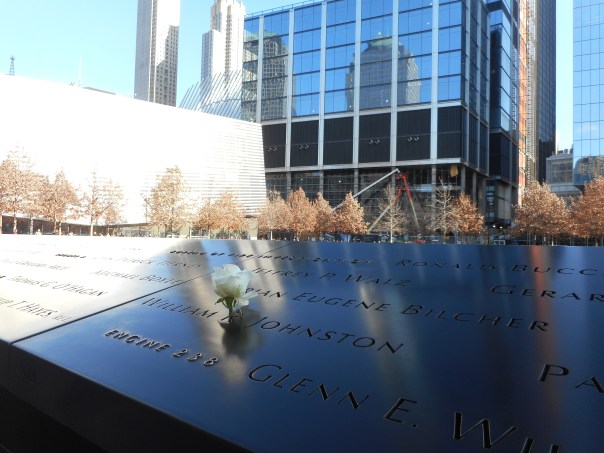
Memorial Footprint of the North Tower in front of the Freedom Tower
On my last day in New York City, I made sure to venture to Manhattan’s downtown financial district on a pilgrimage to Ground Zero—the site of the terrorist attacks of September 11, 2001. It’s been over fifteen years now since that fateful September morning, but I can still recall witnessing the events live on television. The attacks of that day shook America and signaled the beginning of a different era. The events that took place in those city blocks in lower Manhattan are likely to be the defining event of my generation’s lifetime. I had to visit.
As I walked south to the 9/11 memorial, I stopped at a small park between Broadway and Greenwich Streets. Here, in this small triangle of land, an office building once stood that was destroyed in the attacks. Having already taken my first glimpses of the immense Freedom Tower and the other hi-rise redevelopments along the way, I stopped in the park to have lunch. The scene I witnessed at the park was something that could have come nearly anywhere out of New York City. People in business casual rushed about, tourists ambled around cameras in hand, stop-and-go traffic rolled by.
My attention was drawn to a group of students eating lunch in the park. The students were young, maybe fourth grade, but around the same age I was when the attacks happened. These students sat energetically on the benches, chatting and frolicking as they ate the way you’d expect any group of elementary students to do. The gravity which I felt at visiting the memorial was not shared by these students. Theirs was a normal day—better yet, a field trip day to be excited about.
When I was an 11 year-old fifth grader in 2001, I could sense the seriousness of the situation that was unfolding. I was old enough to know that a national tragedy was in progress. I could know enough that this day more so than others would shape the character of the future.
Yet do the grade-schoolers in the triangular park know what that day had changed? Their entire lives have occurred after that day. Have they grown up knowing that there was ever anything different?
Then I thought about what September 11 had changed for me. I was a child then. I did not know the world as I know it now. But I can tell that our culture has shifted to place a much higher value on security than freedom. Visiting the 9/11 Museum, I expected nothing less than a full security screening—symbolic of how our standard cultural expectations of what’s acceptable have changed. But I don’t expect such intense security measures to get into the visitor center of the Charlestown Naval Yard in Boston. Fifteen years later and our culture still clings to quixotic measures of security. As a culture, we’ve taken a default of viewing people as a threat. On that September day, a part of our liberty died that has never recovered.
As I continued to eat my lunch in the park, I kept thinking of those students. The normalcy of their interactions struck me. Their daily life didn’t seem much to be directly affected by the attacks. Elsewhere, the resilient people of New York have recovered and continue hurriedly about their business. Ground Zero, once devastated, has been rebuilt with gleaming towers beaming into the sky. Large promotional posters gawk about the experience of going up to the observatory at the top of the Freedom Tower. The cultural and economic powerhouse that is New York City lets no opportunity for commerce go to waste due to an air of sentimentality. The hum of city life honors the living while the nearby memorial pays tribute to the dead.

Barn Raising on the River
What’s a ship to do when its river freezes in the winter?
While some boats transit to milder climes and others get pulled into dry-dock, there remain some ships that stick out the winter in the river.
The sloop Clearwater is one of those boats that remains in the water. Her winter home is on Rondout Creek in Kingston, New York, just a stone’s throw from the Rondout’s confluence with the Hudson River. The Rondout—once the bustling terminus of the Delaware and Hudson Canal, a thriving commercial shipyard, and a port of call for daily steamer traffic—is much quieter in today’s age, though it still well knows the hum of water traffic.
The sailing season for Clearwater ended October 31 with nothing short of a Halloween-themed sail and a crew dressed up as Peter Pan and the lost boys. The final sail—a sunset cruise—was pleasant and mild. It seemed a shame to put the boat to bed for winter with such a slew of nice days in the forecast. But as the temperature inevitably falls with the autumn leaves, the onslaught of cold wind and occasional snow flurries signals the forlorn truth that the end is nigh.
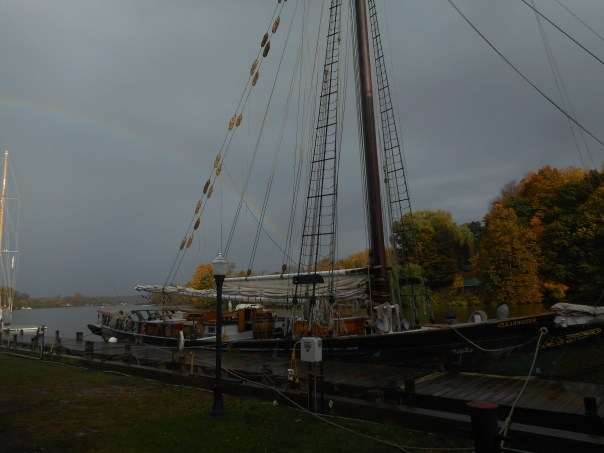
Clearwater in late October, fully rigged, before the end of sailing season
To prepare our boat for winter, we, the crew, must begin to disassemble the ship that has been our work and our home for the past summer. The process is called downrigging—taking off all the equipment on a boat that makes it sail. Anything that can come off the boat and be securely stored out of the winter elements will come in—sails, ropes, blocks, rigging, etc. We take the wind out of Clearwater’s sails—the 4,300 square-foot mainsail (the third largest in America) gets tightly rolled and unlashed from the rigging. It takes a full crew to finagle the hefty fabric sail into the loft of the storage barn. The boom, coming in at 65 feet long and weighing over 1,000 pounds, is removed from the main mast and dropped onto shore using the rigging that once raised the sails. Even the 30-foot tall top mast, from its perch high atop the main mast, comes down and reduces the height of the Clearwater to a squat 80 feet. On the deck, storage boxes and even the tiller disappear into the barn. The good sloop Clearwater, no longer a sailboat per se, is reduced to a shell of herself.
Clearwater’s naked deck and down-rigged mast don’t stand exposed for long. While the weather remains favorable there is much work to be done in preparation for winter. The shed—a barn-like structure—must be raised on the ship. Framed like a long, squat shanty house, the modular shed quickly gets pieced together. Like barn-raisings of yore, this step requires the community effort of the sloop crew to raise the rafters before the structure holds itself in place. In just a matter of days, the sloop transforms from sailboat to floating house.
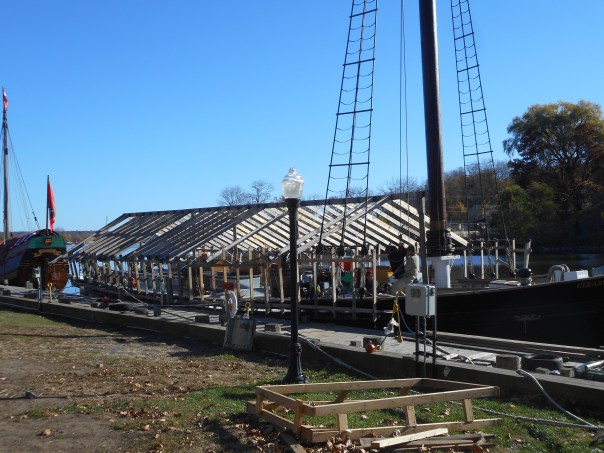
Fully downrigged and the framing of the shed is taking place
This framed package of a ship does not stay open either. A thick white plastic becomes its skin and gives the barn on a ship its façade. Huge rolls of heavy plastic are strung over the rafters. Using a flamethrower (on a wooden boat of all places), the crew heats the plastic covering to tidily shrink-wrap the ship for winter. From the outside, the Clearwater stands as a neatly-wrapped package waiting to be opened once spring arrives. Inside the cover there lies a furnace that keeps the ship’s bilges heated to a low temperature just above freezing. After all, it’s not good to turn the bilge water in a wooden boat into popsicles.
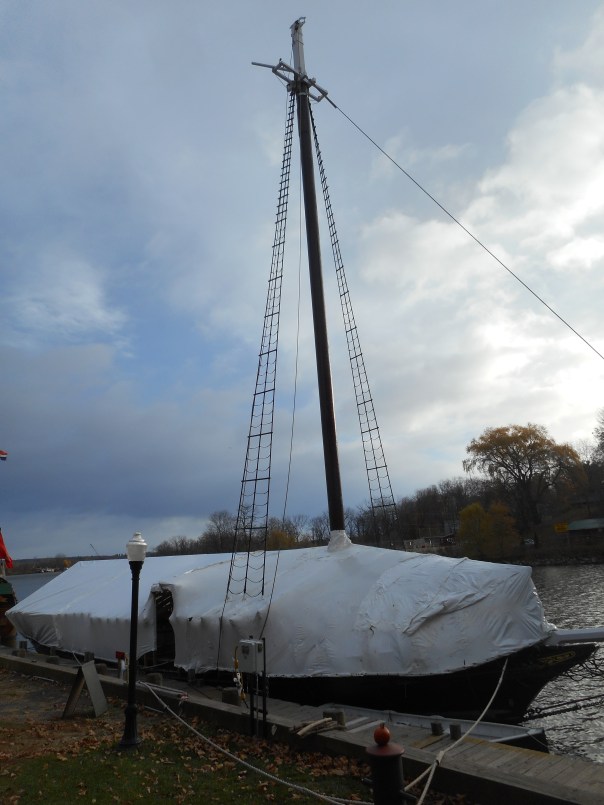
Shrink-wrapped for the season
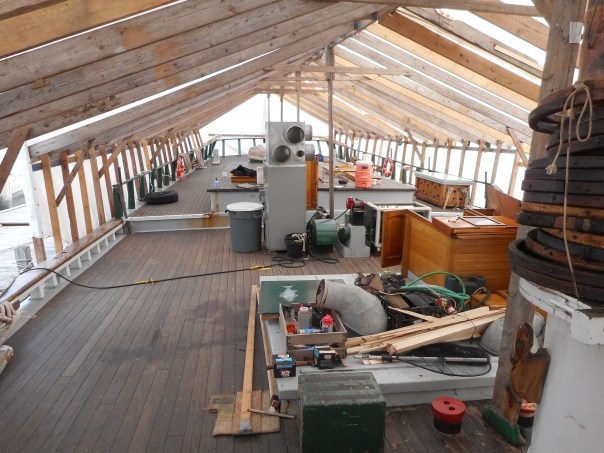
Inside the shed, the deck is being prepared for winter
Out on the Rondout, cold waters continually flow back and forth with the tides. Ice will soon cover the creek higher up in the watershed, but giant logs placed around the hull will form a protective barrier from flowing ice, and bubblers will aerate the surrounding water to keep it from freezing. A skeleton winter crew will stand guard over the ship all winter, protecting her from the elements while they mend sailing-season wear and tear. Through the depths of winter, Clearwater will sit quietly, awaiting the arrival of spring.

How Now Shall We Live?
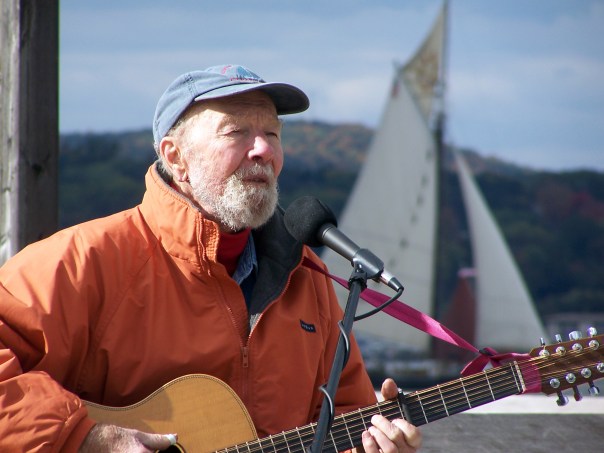
Pete Seeger, folk singer and activist, founder of the Clearwater (c) Dona Crawford
The dark cloud lingering over the national election is passing, but even darker clouds loom on the late-January horizon. The future of the nation seems to be a spiral of uncertainty. Gains in social progress and human rights hard-fought for over the decades seem to be at risk to an ideology of fear and distrust. How could America stoop so low to have this happen?
It’s easy to get cynical about national elections. Being registered to vote in a deeply red state (Idaho), I knew a vote either way wouldn’t change the national outcome. The Electoral College masks the voice of the people, instead turning the power of the popular vote into a pundit’s game. But with extra hope for democracy, I made sure to cast my absentee ballot. In the end, my suspicions were proven; my presidential vote far from mattered, with the winning candidate leading by 31 percentage points in my state regardless.
I watched the outcome on election night with my shipmates in New York, hovering over a smartphone below decks as the results trickled in. Hopes for a promising outcome were initially high. An air of disbelief gradually set in as key states on the east coast began to turn solidly red. Optimism gradually dampened. Late into the night, the tone turned somber and morose as the reality of the outcome sunk in.
There would have been no other place I’d rather be to watch the results than on the Clearwater. The ship is meant to be a safe place. It is meant to be an inclusive community, free from the hate and bigotry that have marred recent national politics. Individuals from all walks of life find themselves aboard the Clearwater. Whether you like the people you end up around on the ship often becomes irrelevant when you must cooperate with each other to form a functioning environment (though I’d say we really do actually like each other aboard the Clearwater). We’re all we have on the ship; we have to look out and take care of each other no matter who we may be.
I wish the ship could serve as a model for how our nation ought to operate. America is a vast mosaic of cultures and ideas and values that has been functioning continuously for over 260 years. The social narrative of this nation has been one of gradually recognizing that the inalienable rights originally granted in the Constitution are inherent to every human being—rights for women, ethnic minorities, indigenous people, religious groups, refugees, gender identities, sexual orientations, disabilities, immigrants, the impoverished and beyond. At the large national scale, it’s easy to become afraid of those groups of people who are different than you. We preferentially segregate ourselves to be with others similar to us. The outsiders—they are unknown, impersonal, different. They might try and change our comfortable status quo, we reason. When relations with the alien other remain impersonal, it’s easy to slip into stereotyping and generalizing fear and distrust. But if instead we were to know our neighbors—to actually learn who we are in community with—how different could things be? In the words of Clearwater’s founder Pete Seeger, “I want to turn the clock back to when people lived in small villages and took care of each other.” If only our nation could behave like a small village, knowing and understanding our neighbors, then maybe cooperation and compassion could win out over fear.
Personally, I’d hate to slip into the cynicism that I have no control in how the nation goes. We’re the second largest democracy in the world, holder of the largest worldwide economy, and home to 320 million people. America is an immense nation; an individual can easily feel overwhelmed by changes in national politics. But the future of our society, I believe, must be won at the level of the individual. Grassroots efforts at change in this nation have and will continue to bubble up and will ultimately succeed in crafting a society of equality and fraternity. These efforts will face many setbacks along the way. But keep on. Don’t get disheartened. As grassroots activist Pete Seeger believed, “the world is going to be saved by millions of small things. Too many things can go wrong when they get big.” Though cynical about politics on a national and even a state level, I know voting still remains a fundamental act of resistance. Be part of your community. Go and vote in local elections.
The people’s voice may not have been heard this time, but we will be heard in the future. In the meantime, there is work to be done in the village. Bigotry and hate start locally, even within oneself. This must be stamped out. But it won’t be easy.
“If only it were all so simple! If only there were evil people somewhere insidiously committing evil deeds, and it were necessary only to separate them from the rest of us and destroy them. But the line dividing good and evil cuts through the heart of every human being. And who is willing to destroy a piece of his own heart?”
― Aleksandr Solzhenitsyn, The Gulag Archipelago

Still Looking ‘In All Directions’
One year ago I was a new arrival in Sydney, Australia, at the advent of my Australian adventure and my project of greater explorations into a meaningful life path. The launch of this blog, In All Directions, shortly preceded my departure and was intended as a chronicle of my travels in Australia—and also an experimental method of reflection and self-discovery along the way.
When I arrived in Australia in late October 2015, I had intentions of staying well over a year. My grandiose scheme had me finishing up a year of fruit picking at about this time and preparing to go on a circumnavigational road trip of the Australian continent as a way to spend my heaps of fruit picking money. A year later, instead of tramping in a van Down Under, I find myself living aboard a sailboat on New York’s Hudson River. Ending up at this particular spot wasn’t even on my radar one year ago, but due to the course of time, it simply ended up being the most reasonable next step to pursue. It’s intriguing the way that the passage of time makes one think about different possibilities with fresh attitudes. Nonetheless, through all my itinerant travels, this blog stuck to chronicle the journey.
One year into the In All Directions project and I can’t come up with any defining conclusions although I can still say it’s been worth the while to continue the exploration. In the past year, I’m more than happy at having tried three different directions: fruit picking in Australia, leading canoe trips in Wisconsin, and working aboard a tall ship in New York. Each of these directions had their individual benefits and drawbacks, but more importantly they have taught me lessons about myself and my proclivities. I can’t say that I’m close to a final discovery, or that I even believe there will ultimately be a final discovery; what I can say is that I have a better idea of what works and what doesn’t work for me. Anecdotally, Thomas Edison failed to make a working lightbulb after over 1,000 prototypes, but each failed trial led him closer to eventual success. When asked by a reporter about how it felt to fail so many times, Edison wisely replied that he didn’t fail at all—making a lightbulb was just a project with 1,000 steps. Like Edison, I’m not classifying things that didn’t quite work out as failures; I’m just refining what works for me and what doesn’t.
In everyday life, we all learn from our past experiences. But in order to gain those experiences, we must travel further down the one-way road of time. And to travel that road means going into an unknown future. Along the way you’ll encounter forks and decisions that will affect your route. You can’t travel back and do it all over again; the best you can do is trust yourself that what path you’re going down is heading towards the best outcome. This isn’t a Panglossian philosophy that all things ultimately work out in the best of all possible ways. More simply this is saying that no matter how life unravels itself, there is some measure of good to be made of the situation.
As I continue to try out different career paths and play with different ideas about my future, each direction I try out could lead me down a different path. One year ago I didn’t anticipate that I’d be writing a retrospective blog from Kingston, New York. But that’s what ended up happening anyway. The way life works is that it can only be viewed in retrospect. The future remains an intriguing mystery. One will never know what each path will look like until it’s been traveled.
Unlike my well-laid out Australian plans, life is not something you can plan out meticulously; life is something that you have to live through to understand where the experience is taking you. To get where I ended up right now, I could have taken many a multitude of paths. But on each of those infinite possible journeys, the lessons learned along the way would have been different; a slightly different person would arrive at each destination. Each journey undertaken is unique; chose to embrace the passages that add to the depth of your character.
There are many directions left to be explored, and I too look forward to seeing where they lead.

The Turning of the Seasons

Autumn in the Hudson River Valley and the Catskill Mountains
There is a distinct chill lingering in the air, one that stymies facial expressions into subdued smirks. That chill announces a period of oncoming change, none less than the switching of the seasons. Autumn is arriving. One can tell so through the senses.
Autumn comes once again to the temperate regions of the world, bringing with it such wondrous transitions not seen in milder climes. Though the environmental change is profound, it remains entirely cyclical and expected. We’ve seen this transformation before, we know the experience of it. Come early September, we wait longingly for its complete arrival. The transmutation of summer into autumn becomes a well-esteemed and anticipated annual ritual.
In the deciduous forests, leaves swap their productive green plurality of chlorophyll in exchange for the brighter hues of reds, oranges, and yellows that have lain hidden all summer. The hillsides now brag of their newly revealed adornments. Stiff breezes off land and water blow over the colorful scene with a mission to expunge the trees of their brightness; hoarse rattling resounds from the crisping leaves. Like the well-loved narrative, one knows the end result of this tragedy: eventually the biting winds will win, taking all the leaves from their hosts in the onslaught of winter. But one nonetheless watches the scene in suspense—will it happen today? In this breeze? Maybe, just maybe, this time around the colors will last.
As the chilling breeze steals away foliage, run and catch a falling leaf in your hand. More and more will follow. Hold the virgin leaves while they are still leathery, before the desiccating wind turns them to a crispy brown. Even on the ground the liveliness of the leaves continues their animation. Swept up in windy whirlpools, blown into piles against a fence. Dried to the perfect crispiness and heaped high on the ground, the leaves become the ideal frolicking ground.

The sloop Clearwater at an autumnal dock scene
Autumn’s cast of critters scurry along with the busyness of the season. For quite some time now, Canadian Geese have been making their great pilgrimages south, flying in their iconic V’s. See them stop along the way and listen to their travelling calls. In the forests, woodland creatures are making ready their nests. The humorous scolding of the squirrel seems to become more frantic in this changing weather; there is much work to be done to prepare.
The fruits of summer’s prodigiousness are ripening. Summer crops like peppers and tomatoes have long since been mortally wilted by the first frost. Hardy root vegetables, thick from a summer of growth, now find their way to local markets. Apples in the orchards hang heavy on the trees, lusting to be picked. In a field of desiccated weeds off in the countryside, bright orbs of orange bring color to the season; the pumpkin patch has risen to the occasion.
You can tell the arrival of autumn by the feel of the air against your face. Mornings are chilly. Maybe even the ground is covered in a fine latticework of shimmering white ice crystals. Gradually later each time, that low-angled ball of sun will rise in the eastern sky. Frost disappears as soon as the warming rays of morning sunlight hit. Later on in the day, the temperature becomes mild and pleasant. It’s tepid in the sun, but even the gentlest breeze steals away warmth so readily.
When that undeniable autumn chill is in the air, it’s time to gather close and gravitate towards the warm cozy places of life. Spend a night out by a bonfire. Your face and hands will radiate with heat while the rest of your body gets comfortably cold. Head inside and warm up by a fire with hot apple cider and fresh pumpkin doughnuts. Autumn is a time to spend close to others.
Cherish the days that are to be found in the turning of the seasons, for the eternal narrative of change continues on in the temperate latitudes. Already the harsh breezes of winter have hinted at their arrival. The first snow of the season has already made a brief but fleeting appearance. The fecundity of life is swiftly on its way to hiding for a long idyll. Winter will soon make the world appear calm and dead. But for now, the activity of fall abounds.
 In All Directions